
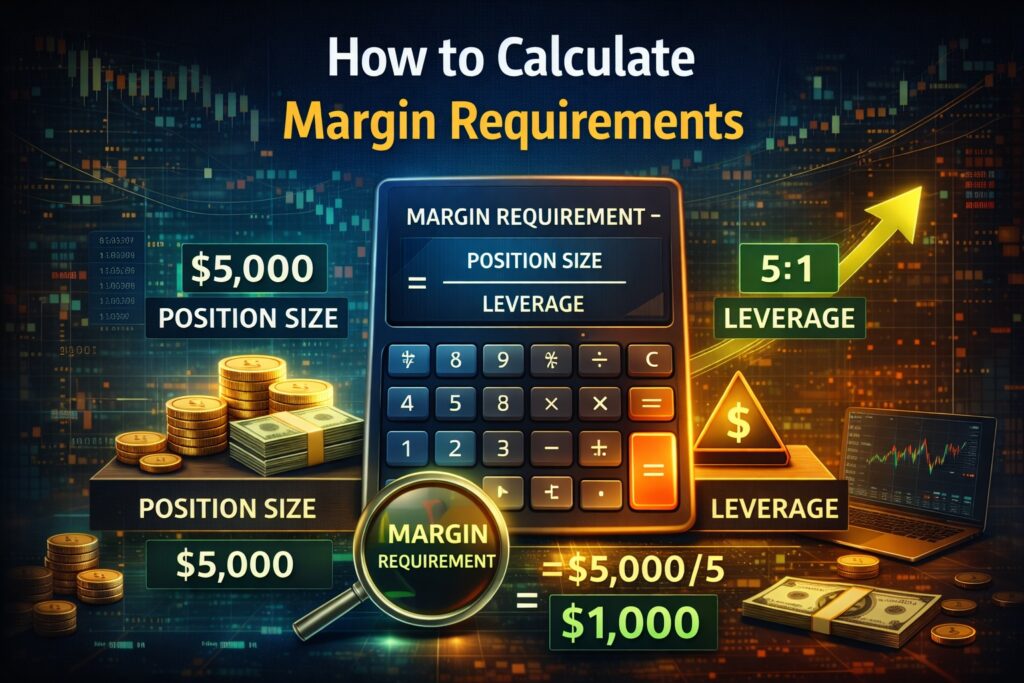
How to Calculate Margin Requirements matters because leverage-based trading performance depends on execution math, risk control, and account structure. This guide explains the concept in practical language with formulas, examples, and actionable rules for retail traders in Google US search context. For related context, see what is margin in trading? explained simply.
- Margin Calculation Formula
- Forex Example
- Stock Example
- Futures Example
- How Brokers Calculate Maintenance Margin
- Using Margin Calculators (MT4/MT5)
- Common Mistakes in Margin Calculations
- Key Takeaways
- FAQ
- What is the basic margin formula?
- Why does required margin change by asset?
- Do brokers use different maintenance rules?
- Can MT4/MT5 help with margin planning?
- What causes margin miscalculations?
Margin Calculation Formula
Margin Calculation Formula is a core topic in leverage and margin education. Traders should evaluate mechanics, context, and risk before position entry. The practical objective is consistency: preserve equity, control drawdown, and keep margin buffers stable across changing volatility regimes. Margin Calculation Formula is a core topic in leverage and margin education. Traders should evaluate mechanics, context, and risk before position entry. The practical objective is consistency: preserve equity, control drawdown, and keep margin buffers stable across changing volatility regimes. Margin Calculation Formula is a core topic in leverage and margin education. Traders should evaluate mechanics, context, and risk before position entry. The practical objective is consistency: preserve equity, control drawdown, and keep margin buffers stable across changing volatility regimes. Margin Calculation Formula is a core topic in leverage and margin education. Traders should evaluate mechanics, context, and risk before position entry. The practical objective is consistency: preserve equity, control drawdown, and keep margin buffers stable across changing volatility regimes. Margin Calculation Formula is a core topic in leverage and margin education. Traders should evaluate mechanics, context, and risk before position entry. The practical objective is consistency: preserve equity, control drawdown, and keep margin buffers stable across changing volatility regimes. For related context, see what is a margin call? causes and prevention.
Forex Example
Forex Example is a core topic in leverage and margin education. Traders should evaluate mechanics, context, and risk before position entry. The practical objective is consistency: preserve equity, control drawdown, and keep margin buffers stable across changing volatility regimes. Forex Example is a core topic in leverage and margin education. Traders should evaluate mechanics, context, and risk before position entry. The practical objective is consistency: preserve equity, control drawdown, and keep margin buffers stable across changing volatility regimes. Forex Example is a core topic in leverage and margin education. Traders should evaluate mechanics, context, and risk before position entry. The practical objective is consistency: preserve equity, control drawdown, and keep margin buffers stable across changing volatility regimes. Forex Example is a core topic in leverage and margin education. Traders should evaluate mechanics, context, and risk before position entry. The practical objective is consistency: preserve equity, control drawdown, and keep margin buffers stable across changing volatility regimes. Forex Example is a core topic in leverage and margin education. Traders should evaluate mechanics, context, and risk before position entry. The practical objective is consistency: preserve equity, control drawdown, and keep margin buffers stable across changing volatility regimes. For related context, see margin level vs free margin explained.
Stock Example
Stock Example is a core topic in leverage and margin education. Traders should evaluate mechanics, context, and risk before position entry. The practical objective is consistency: preserve equity, control drawdown, and keep margin buffers stable across changing volatility regimes. Stock Example is a core topic in leverage and margin education. Traders should evaluate mechanics, context, and risk before position entry. The practical objective is consistency: preserve equity, control drawdown, and keep margin buffers stable across changing volatility regimes. Stock Example is a core topic in leverage and margin education. Traders should evaluate mechanics, context, and risk before position entry. The practical objective is consistency: preserve equity, control drawdown, and keep margin buffers stable across changing volatility regimes. Stock Example is a core topic in leverage and margin education. Traders should evaluate mechanics, context, and risk before position entry. The practical objective is consistency: preserve equity, control drawdown, and keep margin buffers stable across changing volatility regimes. Stock Example is a core topic in leverage and margin education. Traders should evaluate mechanics, context, and risk before position entry. The practical objective is consistency: preserve equity, control drawdown, and keep margin buffers stable across changing volatility regimes. For related context, see what is leverage in forex and stocks?.
Futures Example
Futures Example is a core topic in leverage and margin education. Traders should evaluate mechanics, context, and risk before position entry. The practical objective is consistency: preserve equity, control drawdown, and keep margin buffers stable across changing volatility regimes. Futures Example is a core topic in leverage and margin education. Traders should evaluate mechanics, context, and risk before position entry. The practical objective is consistency: preserve equity, control drawdown, and keep margin buffers stable across changing volatility regimes. Futures Example is a core topic in leverage and margin education. Traders should evaluate mechanics, context, and risk before position entry. The practical objective is consistency: preserve equity, control drawdown, and keep margin buffers stable across changing volatility regimes. Futures Example is a core topic in leverage and margin education. Traders should evaluate mechanics, context, and risk before position entry. The practical objective is consistency: preserve equity, control drawdown, and keep margin buffers stable across changing volatility regimes. Futures Example is a core topic in leverage and margin education. Traders should evaluate mechanics, context, and risk before position entry. The practical objective is consistency: preserve equity, control drawdown, and keep margin buffers stable across changing volatility regimes. For related context, see leverage and margin in trading: complete guide.
How Brokers Calculate Maintenance Margin
How Brokers Calculate Maintenance Margin is a core topic in leverage and margin education. Traders should evaluate mechanics, context, and risk before position entry. The practical objective is consistency: preserve equity, control drawdown, and keep margin buffers stable across changing volatility regimes. How Brokers Calculate Maintenance Margin is a core topic in leverage and margin education. Traders should evaluate mechanics, context, and risk before position entry. The practical objective is consistency: preserve equity, control drawdown, and keep margin buffers stable across changing volatility regimes. How Brokers Calculate Maintenance Margin is a core topic in leverage and margin education. Traders should evaluate mechanics, context, and risk before position entry. The practical objective is consistency: preserve equity, control drawdown, and keep margin buffers stable across changing volatility regimes. How Brokers Calculate Maintenance Margin is a core topic in leverage and margin education. Traders should evaluate mechanics, context, and risk before position entry. The practical objective is consistency: preserve equity, control drawdown, and keep margin buffers stable across changing volatility regimes. How Brokers Calculate Maintenance Margin is a core topic in leverage and margin education. Traders should evaluate mechanics, context, and risk before position entry. The practical objective is consistency: preserve equity, control drawdown, and keep margin buffers stable across changing volatility regimes.
Using Margin Calculators (MT4/MT5)
Using Margin Calculators (MT4/MT5) is a core topic in leverage and margin education. Traders should evaluate mechanics, context, and risk before position entry. The practical objective is consistency: preserve equity, control drawdown, and keep margin buffers stable across changing volatility regimes. Using Margin Calculators (MT4/MT5) is a core topic in leverage and margin education. Traders should evaluate mechanics, context, and risk before position entry. The practical objective is consistency: preserve equity, control drawdown, and keep margin buffers stable across changing volatility regimes. Using Margin Calculators (MT4/MT5) is a core topic in leverage and margin education. Traders should evaluate mechanics, context, and risk before position entry. The practical objective is consistency: preserve equity, control drawdown, and keep margin buffers stable across changing volatility regimes. Using Margin Calculators (MT4/MT5) is a core topic in leverage and margin education. Traders should evaluate mechanics, context, and risk before position entry. The practical objective is consistency: preserve equity, control drawdown, and keep margin buffers stable across changing volatility regimes. Using Margin Calculators (MT4/MT5) is a core topic in leverage and margin education. Traders should evaluate mechanics, context, and risk before position entry. The practical objective is consistency: preserve equity, control drawdown, and keep margin buffers stable across changing volatility regimes.
Common Mistakes in Margin Calculations
Common Mistakes in Margin Calculations is a core topic in leverage and margin education. Traders should evaluate mechanics, context, and risk before position entry. The practical objective is consistency: preserve equity, control drawdown, and keep margin buffers stable across changing volatility regimes. Common Mistakes in Margin Calculations is a core topic in leverage and margin education. Traders should evaluate mechanics, context, and risk before position entry. The practical objective is consistency: preserve equity, control drawdown, and keep margin buffers stable across changing volatility regimes. Common Mistakes in Margin Calculations is a core topic in leverage and margin education. Traders should evaluate mechanics, context, and risk before position entry. The practical objective is consistency: preserve equity, control drawdown, and keep margin buffers stable across changing volatility regimes. Common Mistakes in Margin Calculations is a core topic in leverage and margin education. Traders should evaluate mechanics, context, and risk before position entry. The practical objective is consistency: preserve equity, control drawdown, and keep margin buffers stable across changing volatility regimes. Common Mistakes in Margin Calculations is a core topic in leverage and margin education. Traders should evaluate mechanics, context, and risk before position entry. The practical objective is consistency: preserve equity, control drawdown, and keep margin buffers stable across changing volatility regimes.
Key Takeaways
- Use leverage as a risk tool, not a speed tool.
- Keep free margin buffer and monitor margin level.
- Size from risk-per-trade, not max available ratio.
- Model liquidation pathways before entry.
- Consistency beats aggressive exposure.
FAQ
What is the basic margin formula?
Use conservative sizing, monitor margin metrics, and align leverage with strategy horizon and volatility conditions.
Why does required margin change by asset?
Do brokers use different maintenance rules?
Can MT4/MT5 help with margin planning?
What causes margin miscalculations?
Risk control and execution discipline should be reviewed before every trading session.