When people talk about financial markets, they often mention two broad categories of participants: retail traders and institutional traders. While both groups buy and sell the same types of assets—stocks, currencies, commodities, or crypto—their approaches, resources, and influence on the market are vastly different.
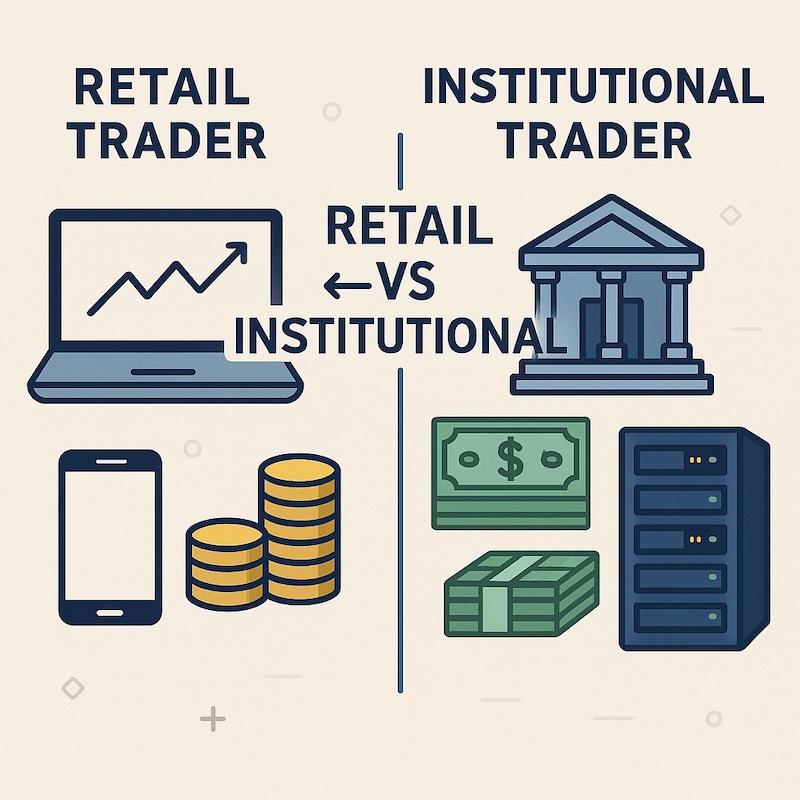
For beginners, understanding the difference between retail and institutional trading is crucial. It sheds light on why markets move the way they do and what challenges and opportunities exist for individual investors.
- What Is a Retail Trader?
- What Is an Institutional Trader?
- Key Differences Between Retail and Institutional Trading
- 1. Capital
- 2. Tools and Technology
- 3. Information Access
- 4. Market Impact
- How Institutions Impact Markets
- Key Takeaways
- FAQ
- Can retail traders compete with institutions?
- Do institutions always win in trading?
- Why do institutions move markets more?
- Are retail traders disadvantaged?
- Can retail traders copy institutional strategies?
What Is a Retail Trader?
A retail trader is an individual who buys and sells financial instruments with their own money, typically through a brokerage account or trading app. These are everyday investors and speculators who trade from home, often part-time or as a hobby, though some do it full-time.
- Capital: Limited compared to institutions—often anywhere from a few hundred to a few hundred thousand dollars.
- Tools: Access to online brokers, charting platforms, and educational resources, but not the same level of institutional infrastructure.
- Motivations: Building wealth, short-term profits, or learning how markets work.
- Examples: Someone trading Tesla stock via Robinhood, or a forex hobbyist speculating on EUR/USD through MetaTrader.
Retail traders have grown dramatically in recent years, thanks to zero-commission trading apps and online communities. Events like the GameStop short squeeze in 2021 highlighted the collective influence retail traders can occasionally have.
What Is an Institutional Trader?
An institutional trader represents a large organization such as a hedge fund, investment bank, pension fund, or insurance company. These institutions manage vast sums of money—sometimes billions or even trillions of dollars—on behalf of clients, governments, or corporations.
- Capital: Enormous compared to retail, allowing them to move markets with a single trade.
- Tools: Access to advanced technology, algorithms, proprietary research, and direct market connections.
- Motivations: Maximizing returns for clients, hedging risks, and executing large-scale investment strategies.
- Examples: BlackRock managing ETFs, Goldman Sachs executing trades for institutional clients, or a pension fund allocating capital to equities and bonds.
Institutional traders often act as “market makers,” providing liquidity that helps keep markets efficient.
Key Differences Between Retail and Institutional Trading
Although both groups participate in the same markets, the playing field looks very different.
1. Capital
- Retail: Smaller accounts, often in the thousands.
- Institutional: Billions of dollars under management.
2. Tools and Technology
- Retail: Use publicly available platforms, charting software, and news feeds.
- Institutional: Employ algorithmic trading, AI-driven analytics, direct access to exchanges, and co-location servers to reduce latency.
3. Information Access
- Retail: Rely on public financial reports, online news, and forums.
- Institutional: Access to proprietary research, direct company meetings, and analyst networks.
4. Market Impact
- Retail: Individually, their trades rarely move markets.
- Institutional: Large orders can influence stock prices, currency pairs, or commodities significantly.
How Institutions Impact Markets
Institutional traders are the backbone of modern financial markets. Their actions shape liquidity, volatility, and even long-term asset prices.
- Liquidity Providers Institutions often act as market makers, constantly buying and selling to ensure smooth market functioning. Without them, bid-ask spreads would be wider, making trading more expensive for everyone.
- Price Discovery With their vast resources, institutions analyze markets deeply and contribute to efficient pricing. Their trades help reflect real-time expectations about company earnings, interest rates, and economic trends.
- Market Trends When institutions enter or exit a position, their size can create noticeable trends. For example, large hedge funds shifting into commodities may push oil or gold prices higher.
- Stability and Risk Pension funds and insurance companies invest with long-term horizons, providing stability to markets. On the other hand, aggressive hedge fund strategies can increase volatility.
Key Takeaways
- Retail traders are individuals trading with personal funds, often using online platforms.
- Institutional traders represent large organizations managing vast amounts of capital.
- The difference between retail and institutional trading lies in capital size, tools, information access, and market impact.
- Institutions play a central role in liquidity, price discovery, and long-term market trends.
- Retail traders, while smaller in influence, are important contributors to market activity and have grown in significance thanks to technology.
FAQ
Can retail traders compete with institutions?
Yes, but on different terms. While institutions have more capital and better tools, retail traders benefit from agility, independence, and the ability to take risks institutions cannot.
Do institutions always win in trading?
Not always. Institutions have advantages, but they also make mistakes. Retail traders can succeed, especially by focusing on niches, long-term investing, or strategies where flexibility matters.
Why do institutions move markets more?
Their sheer trade size can shift prices, while retail traders’ individual trades are too small to affect markets significantly.
Are retail traders disadvantaged?
In some ways, yes. Institutions enjoy better technology and research. But retail traders also face fewer restrictions, no reporting obligations, and can enter or exit positions quickly.
Can retail traders copy institutional strategies?
To an extent. Tools like ETFs and public filings (e.g., 13F reports in the U.S.) let individuals mirror institutional positions, but without identical resources.
See also: Tradium trading guides and glossary.