
A trader with $1,000 controls a $100,000 position — that sounds powerful. But what happens if the market moves just 1% against them? In many leveraged markets, that small move can wipe out a large share of account equity within minutes. This is exactly why understanding leverage and margin in trading is not optional. It is core survival knowledge. For related context, see what is leverage in forex and stocks?.
Leverage can accelerate growth when risk is controlled. It can also accelerate losses when position sizing is careless. Margin is the operational mechanism that makes leverage possible: it defines how much capital you must commit to open and maintain a position. Together, leverage and margin form the real execution layer behind many retail and professional strategies in forex, CFDs, futures, and some stock products. For related context, see what is margin in trading? explained simply.
This guide explains the mechanics in plain language, with formulas, realistic trade simulation, and regulatory context from FINRA, ESMA, and ASIC. You will learn what is leverage, what is margin in trading, how margin levels are calculated, what a margin call meaning is in practice, and how to reduce trading with leverage risks. For related context, see what is a margin call? causes and prevention.
- What Is Leverage in Trading?
- What Is Margin in Trading?
- How Leverage and Margin Work Together
- Real Example (Step-by-Step Trade Simulation)
- Benefits of Using Leverage
- Major Risks of Margin Trading
- What Is a Margin Call?
- Leverage Limits by Region
- How to Use Leverage Safely
- Common Mistakes When Trading With Leverage
- Practical Monitoring Framework (Daily and Weekly)
- Leverage Selection Framework for Beginners
- Regulatory Safety Layers and What They Really Mean
- Key Takeaways
- FAQ
- 1. Is leverage the same as margin?
- 2. Can you lose more than your deposit?
- 3. What leverage do professional traders use?
- 4. Why is leverage restricted in some countries?
- 5. Is 1:100 leverage too risky?
- 6. What is negative balance protection?
- 7. Do long-term investors use leverage?
What Is Leverage in Trading?
Snippet definition (40 words): Leverage in trading is a mechanism that lets you control a larger market position using a smaller amount of your own capital. It magnifies gains and losses because your profit and risk are calculated on total position size, not only deposited funds. For related context, see best leverage for beginners.
Leverage is usually shown as a ratio, such as 1:10, 1:50, or 1:100. A 1:10 ratio means every $1 of your capital controls $10 of market value. At 1:100, every $1 controls $100. The ratio does not change market behavior — it changes your exposure intensity. For related context, see what is negative balance protection?.
Typical leverage ranges differ by market:
- Forex: often higher leverage availability for major currency pairs.
- Stocks: usually lower leverage in regulated retail accounts.
- Crypto derivatives: can offer very high leverage, with correspondingly high liquidation risk.
If you are searching “what is leverage” in practical terms, think of it as a force multiplier. It increases efficiency and danger at the same time.
What Is Margin in Trading?
Margin is the capital your broker requires as collateral to open and hold a leveraged position. It is not a fee and not a separate asset class. It is a reserved part of your account balance that supports open risk.
When traders ask “what is margin in trading,” they often confuse it with leverage itself. They are related but not identical. Leverage is the exposure ratio; margin is the collateral requirement that corresponds to that ratio.
Key margin terms:
- Initial margin: required amount to open a position.
- Maintenance margin: minimum account support required to keep the position open.
- Used margin: total margin currently tied to open positions.
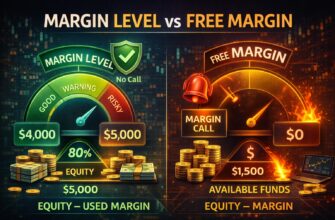
- Free margin: available funds not locked as margin, used to absorb losses or open new trades.
Account type also matters:
- Margin account: supports leveraged trades under broker and regulatory rules.
- Cash account: generally no leverage (or far more limited leverage behavior).
For deeper fundamentals, see What Is Margin in Trading?.
How Leverage and Margin Work Together
Leverage and margin are two sides of one system. Higher leverage reduces required margin per unit of exposure, but also increases how fast equity changes relative to small market moves.
Position Size Formula
Position Size = Capital × Leverage
Margin Requirement Formula
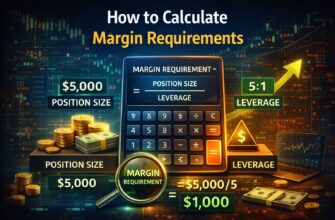
Required Margin = Position Size ÷ Leverage
Example:
- Capital: $2,000
- Leverage: 1:50
- Maximum position capacity: $100,000
- If opening $50,000 position at 1:50, required margin ≈ $1,000
Now combine with equity logic:
- Equity = Balance + Floating P/L
- Margin Level (%) = (Equity ÷ Used Margin) × 100
As floating losses increase, equity drops, margin level drops, and risk of margin call or stop-out increases. This is where margin trading explained becomes operational rather than theoretical.
Real Example (Step-by-Step Trade Simulation)
Let’s run a realistic simulation.
- Deposit: $2,000
- Leverage: 1:50
- Instrument: EUR/USD
- Position size: 1 standard lot (~$100,000 notional)
Step 1: Open trade
At 1:50, required margin for ~$100,000 exposure is roughly $2,000. That means most of your capital is now used margin.
Step 2: Market moves 2% against the position
A 2% adverse move on $100,000 notional is about $2,000 unrealized loss.
Step 3: Recalculate equity and margin level
- Balance: $2,000
- Floating P/L: -$2,000
- Equity: $0
- Used margin: ~$2,000
- Margin level: (0 / 2,000) × 100 = 0%
At this stage, position closure would likely happen much earlier due to stop-out thresholds. The simulation shows how quickly risk escalates when position size is too large for account equity.
For execution detail on margin stress events, see What Is a Margin Call?.
Benefits of Using Leverage
Leverage is not inherently bad. Used correctly, it offers meaningful advantages:
- Capital efficiency: you do not need full notional capital for every trade idea.
- Strategy flexibility: easier scaling for short-term opportunities.
- Hedging efficiency: smaller collateral can support protective positions.
- Portfolio mobility: unused capital can remain available for diversification or buffer.
These benefits only matter if risk controls are strict. Without risk discipline, leverage advantage quickly becomes leverage damage.
Major Risks of Margin Trading
The risks are concentrated and fast. Core threats include:
- Overleveraging: too much notional exposure for account size.
- Margin calls: broker warning when equity support falls toward maintenance threshold.
- Forced liquidation: broker closes positions at stop-out level to prevent deeper deficit.
- Gap risk: fast price jumps can bypass intended stop logic.
- Psychological pressure: high leverage can trigger impulsive decision loops.
In practice, the largest losses are often not from “wrong direction,” but from wrong size. This is why Best Leverage for Beginners is a critical companion topic.
What Is a Margin Call?
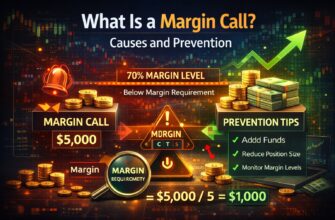
A margin call is a broker alert that your account equity is approaching or below required maintenance levels. It means current losses have reduced margin support and action is required: reduce risk, add funds, or accept partial closure. If deterioration continues, a stop out level trigger can force liquidation automatically. For full mechanics and prevention framework, read What Is a Margin Call?.
Leverage Limits by Region
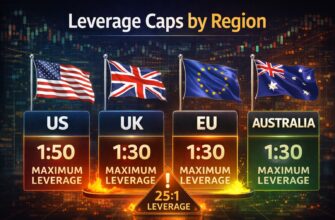
Leverage availability is regulated differently across jurisdictions. Retail protection rules are designed to reduce catastrophic account depletion and misleading marketing practices.
| Region | Regulator | Typical Retail Leverage Framework | Notes |
|---|---|---|---|
| United States | FINRA / NFA context | More conservative product access; strong account and disclosure controls | Strict broker compliance and product-specific requirements |
| UK & EU | ESMA / FCA framework | Retail caps by asset class; stronger retail-protection design | Includes risk disclosures and negative-balance style safeguards in many cases |
| Australia | ASIC | Retail leverage caps and product intervention standards | Focus on reducing harmful overexposure in retail CFD trading |
Rules can evolve. Always verify current broker jurisdiction and product terms before sizing leveraged exposure.
How to Use Leverage Safely
Safety with leverage is process-based. Use the following framework:
- Cap risk per trade (for example, 0.5%–1% of equity).
- Size position from stop distance, not from maximum leverage available.
- Monitor free margin continuously; avoid running near maintenance thresholds.
- Use lower effective leverage than platform maximum.
- Predefine invalidation and exit rules before entry.
- Avoid revenge scaling after fast losses.
- Stress-test strategy for slippage, spread expansion, and volatility clusters.
Beginner baseline: prioritize survivability over speed. Consistent low-risk execution compounds better than occasional high-risk spikes.
For protection framework details, also review Negative Balance Protection and What Is Leverage in Forex and Stocks?.
Common Mistakes When Trading With Leverage
Most leverage failures are process failures before they are market failures. One common mistake is sizing from maximum available leverage instead of sizing from a pre-defined stop and acceptable account risk. If your broker offers 1:100, that does not mean your strategy should operate near that ceiling. Maximum capacity is a technical limit, not a recommendation.
Another frequent mistake is ignoring free margin drift. Traders may focus only on entry and unrealized P/L while forgetting that multiple open positions can slowly compress free margin, leaving no buffer for normal volatility. When free margin gets too thin, even modest price noise can trigger forced action.
A third mistake is failing to model correlation. Two positions on different symbols can still move together under risk-off conditions. Traders assume diversification, but effective leverage is concentrated. In stress periods, correlated losses accelerate equity decline and margin-level deterioration.
Overconfidence after short winning streaks is another classic hazard. High leverage can produce rapid gains, and that feedback loop often leads to stepwise oversizing. Once conditions change, drawdown speed becomes psychologically difficult to manage. This is where discipline, not prediction, determines account survival.
Finally, many accounts fail because traders treat margin call notices as optional information instead of emergency risk signals. A margin call is not “bad luck.” It is a quantitative warning that position structure is too fragile for current account conditions.
Practical Monitoring Framework (Daily and Weekly)
Execution quality in leveraged trading improves when monitoring is systematic. A compact framework can prevent most avoidable margin events:
- Daily checks: equity, used margin, free margin, margin level, and worst-case open risk.
- Per-trade checks: effective leverage, risk-per-trade percentage, and correlation impact with existing positions.
- Weekly checks: average leverage used, number of margin warnings, maximum intraday drawdown, and slippage-adjusted losses.
Set hard thresholds. Example: if margin level drops below an internal safety floor (well above broker stop-out), reduce exposure immediately. If total open risk exceeds predefined limits, no new entries regardless of setup quality. These rules reduce emotional decision-making under pressure.
Also separate strategy risk from execution risk. Strategy risk is direction and setup validity. Execution risk includes spread widening, slippage, partial fills, and latency events. In leveraged accounts, execution risk can be enough to break a trade that looked acceptable in idealized planning.
Documenting these metrics creates a repeatable loop: measure, diagnose, adjust. Over time, this loop is often more valuable than adding another indicator or signal filter.
Leverage Selection Framework for Beginners
New traders usually ask: “How much leverage should I use?” A practical answer is to choose leverage backwards from risk limits, not forwards from platform allowances. Start with risk-per-trade and stop distance, then compute position size. If required leverage exceeds your safety threshold, reduce position size.
A conservative beginner framework:
- Risk per trade: 0.5%–1.0% of equity
- Total open risk across all trades: capped
- Avoid stacking correlated positions with high combined leverage
- Keep meaningful free-margin buffer for volatility
- Scale up only after consistent execution data, not after short-term wins
Use this approach with supporting articles in the cluster: Best Leverage for Beginners and Margin Level vs Free Margin Explained. Structured progression protects capital and improves decision quality.
Regulatory Safety Layers and What They Really Mean
Regulation can reduce retail harm, but regulation is not a substitute for position discipline. A common misunderstanding is that broker rules make high leverage “safe.” In reality, regulators set boundaries, disclosures, and intervention standards, while trade-level survival still depends on your sizing and execution behavior.
ESMA-style protections in many EU contexts include leverage caps by asset class and stronger risk communication. These frameworks aim to reduce extreme overexposure among retail clients. ASIC introduced comparable interventions in Australia to limit harmful retail practices in leveraged derivative products. In the U.S., FINRA-linked account frameworks emphasize stricter account and suitability structures, though product pathways and constraints differ by instrument and venue.
Another misunderstood topic is liquidation mechanics. Some traders assume liquidation always happens at one exact textbook level. In practice, closure can be staged, partial, or accelerated by fast markets, spread expansion, and execution conditions. This is why traders should maintain internal safety thresholds above broker minimums rather than operating close to stop-out triggers.
Finally, risk language in broker marketing should be interpreted critically. Statements about protection features, fast execution, or advanced risk engines do not remove market risk. They only describe infrastructure behavior under stated conditions. Your first protection layer is still conservative position sizing and adequate free-margin buffer.
A practical checkpoint is to define your own “pre-liquidation protocol.” For example: reduce exposure when margin level drops below an internal alert threshold, pause new entries when volatility regime shifts, and reassess all correlated positions before adding leverage. This policy-driven approach converts abstract risk warnings into concrete actions that protect equity under pressure.
Key Takeaways
- Leverage increases exposure; margin is the collateral that enables that exposure.
- Small adverse moves can cause major equity damage when leverage is high.
- Initial margin, maintenance margin, free margin, and margin level are core risk metrics.
- Margin calls are warnings; stop-out is forced liquidation.
- Regulatory limits (FINRA/ESMA/ASIC frameworks) exist to reduce retail harm.
- Position sizing and margin monitoring matter more than chasing high leverage ratios.
FAQ
1. Is leverage the same as margin?
No. Leverage is the exposure multiplier; margin is the collateral required to support leveraged exposure.
2. Can you lose more than your deposit?
In fast markets and depending on product and broker protections, losses can exceed deposit. Check jurisdiction rules and negative balance terms carefully.
3. What leverage do professional traders use?
Many professionals use lower effective leverage than retail maximums, focusing on consistency and risk-adjusted returns rather than maximum notional exposure.
4. Why is leverage restricted in some countries?
Because high leverage can cause rapid retail account depletion; regulators use caps and disclosures to reduce systemic retail harm.
5. Is 1:100 leverage too risky?
It can be, especially for beginners or weak risk controls. Risk depends on effective position sizing, not ratio alone.
6. What is negative balance protection?
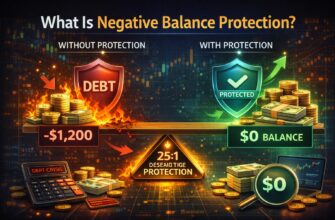
It is a broker/regulatory safeguard designed to limit client losses beyond account balance under specific conditions.
7. Do long-term investors use leverage?
Some do, but usually with conservative structure and lower effective leverage than short-term speculative trading.