Choosing between a market order and a limit order looks simple on the surface: one executes fast, the other controls price. In real trading, that choice affects everything from slippage and fills to your ability to follow a plan under pressure. For context, see limit order.
This guide compares market order vs limit order in practical terms. You’ll learn what each order type does, how execution actually works, and how to decide which one fits your situation—without relying on brand-specific platforms, broker promises, or “secret” tricks. A useful companion topic is stop-loss order.
- Definitions
- What is a market order?
- What is a limit order?
- Execution Speed vs Price Control
- Market orders: fast execution (but uncertain price)
- Limit orders: price protection (but uncertain fill)
- Slippage vs missed trades (the real comparison)
- Examples Side by Side
- Example 1: Entering a trade in normal conditions
- Example 2: Fast-moving market (sudden volatility)
- Example 3: Exiting a losing trade
- Example 4: Taking profit at a planned level
- Example 5: Partial fills (why “limit” can mean “partial”)
- Which Order Type to Use?
- Use a market order when:
- Use a limit order when:
- Common beginner mistakes (and how to avoid them)
- Can you use both in one approach?
- Market vs Limit Order: Quick Comparison Table
- Quick Decision Checklist
- Key Takeaways
- FAQ
- Which is better: market or limit order?
- Can I use both types in one strategy?
- What is the biggest risk of a market order?
- What is the biggest risk of a limit order?
Definitions
What is a market order?
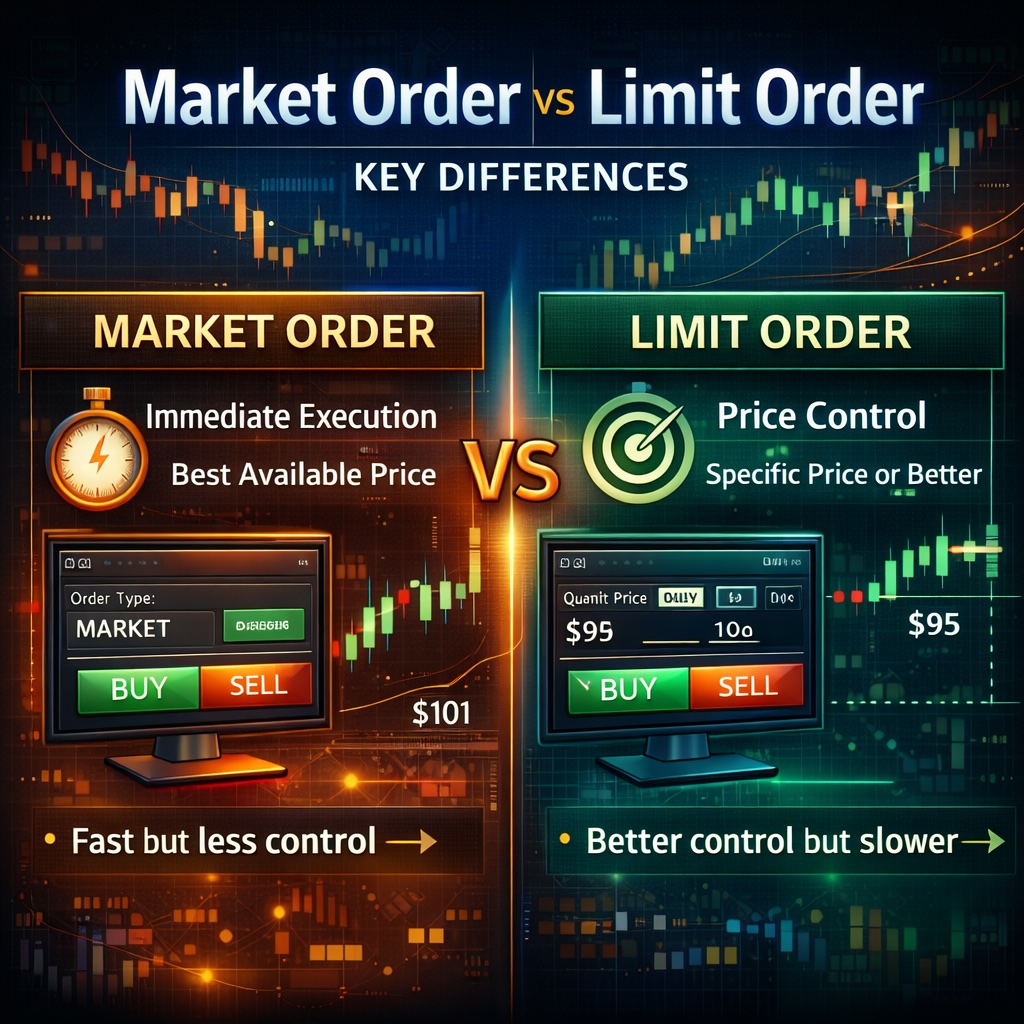
A market order is an instruction to buy or sell immediately at the best available price. You prioritize execution. The trade is designed to happen now, even if the final fill price is slightly different from what you saw a moment ago.
What is a limit order?
A limit order is an instruction to buy or sell at a specific price (or better). You prioritize price control. The trade only happens if the market reaches your limit price and there’s enough liquidity to fill your order.
In one sentence: a market order says “fill me,” while a limit order says “fill me only at this price or better.” You can compare this with take-profit order.
Execution Speed vs Price Control
The main difference between limit and market orders is the trade-off between speed and control. But to use that trade-off correctly, you need to understand what you’re actually giving up in each case. For a deeper execution angle, review partial fill in trading.
Market orders: fast execution (but uncertain price)
Market orders are built for urgency. If you need to enter or exit quickly, they are often the simplest tool. The cost is that you accept whatever price is available right now.
Under the hood, most markets are not “one price.” They are a queue of buy and sell orders at multiple prices and sizes (an order book). When you send a market order, your trade consumes available liquidity starting from the best price and moving outward until your full size is filled. In liquid conditions and small order sizes, the difference is usually tiny. In thin or fast conditions, the difference can be meaningful. Related concept: order execution speed.
Limit orders: price protection (but uncertain fill)
Limit orders are built for rules. You set a threshold and refuse to accept a worse price. That can reduce negative slippage and help you avoid emotional “chase entries.”
The trade-off is fill uncertainty. If price never reaches your level, you won’t trade. If price reaches it briefly, you may get a partial fill. If the market moves away immediately, you might get filled and then see price continue against you. A limit order controls price, not direction.
Slippage vs missed trades (the real comparison)
Many traders compare order types by asking: “Which one avoids slippage?” The more useful question is: “Which failure mode am I willing to accept?”
- Market order failure mode: you get filled, but at a worse price than expected (negative slippage), especially during volatility.
- Limit order failure mode: you don’t get filled at all (or only partially), and you miss the move or end up with a smaller position than planned.
Neither is universally better. The best choice depends on your timeframe, liquidity, volatility, and the purpose of the order (entry, exit, stop, target).
Examples Side by Side
Below are practical scenarios that show how market vs limit execution differs in real conditions.
Example 1: Entering a trade in normal conditions
Assume an asset is trading with a tight spread around $100.00. You want to buy 10 units.
- Market buy: executes immediately near the current ask price. You are in the position right away.
- Buy limit at $99.80: only fills if price trades down to $99.80 (or lower). If it never pulls back, you do not enter.
In calm markets, market orders can be “good enough” for small sizes. Limit orders in this context are less about saving pennies and more about trading a planned level without chasing.
Example 2: Fast-moving market (sudden volatility)
Now imagine price is jumping in seconds. You see $100.00 on screen, but liquidity is being removed and re-posted rapidly.
- Market buy: you might be filled at $100.20 or $100.60 because the best offers disappear before your order is matched.
- Buy limit at $100.00: you avoid paying above $100.00—but you might not get filled if price keeps running.
This is a key difference between market vs limit execution: a market order buys participation; a limit order enforces permission.
Example 3: Exiting a losing trade
Suppose you are long and the market starts moving against you quickly. Your priority is to reduce exposure.
- Market sell: you exit immediately, accepting the best available bids. This is often used when urgency matters.
- Sell limit at a better price: you try to exit higher, but there is no guarantee. If the market continues down, the order may never fill and you remain exposed.
Because of this, many rule-based approaches prefer “certainty tools” for exits that protect downside risk. The order type you choose can directly affect whether your risk rules actually execute when you need them to.
Example 4: Taking profit at a planned level
Taking profit is a different problem than stopping a loss. Here, precision is often useful.
- Market sell: you exit now, but you may give up a planned target if price is close.
- Sell limit at your target: you attempt to exit at a specific level. If price never reaches it, you may stay in the trade longer or miss the intended exit.
Example 5: Partial fills (why “limit” can mean “partial”)
Assume you place a limit order for 1,000 units at $100.00. Price trades at $100.00, but only 600 units are available at that level before price moves away.
- You may receive a partial fill for 600 units.
- The remaining 400 units stay pending (depending on the market and order conditions).
- Your position size and risk may now be different from what you planned.
This is one of the most overlooked “hidden differences” in the market order vs limit order debate: a market order is more likely to fill your full size immediately (at whatever price is available), while a limit order protects price but can leave you with an incomplete execution.
Which Order Type to Use?
Instead of memorizing definitions, choose order types based on what you are optimizing for in the moment.
Use a market order when:
- Execution matters more than price (you must enter or exit now).
- The asset is liquid and spreads are typically tight.
- Your order size is small relative to typical available volume.
- You are closing risk quickly (for example, reacting to a rule-based exit).
Use a limit order when:
- Price matters more than speed (you only want to trade at a certain level).
- You are entering on a pullback or placing a target at a planned level.
- You want to reduce negative slippage by refusing worse prices.
- You can accept the possibility of no fill or a partial fill.
Common beginner mistakes (and how to avoid them)
- Using market orders in illiquid conditions: if spreads are wide or the book is thin, market orders can produce surprisingly bad fills. Consider limits or smaller sizes.
- Placing limits “too perfect”: setting a level that’s unrealistic leads to missed trades. If you repeatedly miss by a tiny amount, reassess your plan rather than constantly adjusting the order.
- Assuming a limit fill means a good trade: limits fill because the market reached your price—not because the trade is “validated.” Always manage risk separately.
Can you use both in one approach?
Yes. Many traders combine order types. For example, a strategy may use limit orders for planned entries and targets, and market orders for urgent exits. The key is to define, ahead of time, which situations require certainty of execution versus certainty of price.
Market vs Limit Order: Quick Comparison Table
| Feature | Market Order | Limit Order |
|---|---|---|
| Main priority | Fast execution | Price control |
| Fill certainty | High (usually fills) | Lower (may not fill) |
| Price certainty | Lower (can slip) | Higher (protected) |
| Best use cases | Urgent entries/exits, highly liquid markets | Planned entries/targets, avoiding paying worse prices |
| Main downside | Negative slippage in fast/illiquid conditions | Missed trades or partial fills |
Quick Decision Checklist
If you’re still unsure which order type to choose, run through this quick checklist before you click “Buy” or “Sell”:
- Is liquidity deep right now? If spreads are tight and the book is thick, market orders are less risky.
- Is volatility elevated? If price is jumping, market orders can slip; strict limit orders can miss.
- Is this an entry, a profit target, or a risk exit? Entries and targets often tolerate waiting; risk exits often require certainty.
- Would a partial fill break your plan? If yes, consider reducing size or choosing order conditions that fit your venue.
- Do you have a clear invalidation point? The order type doesn’t replace risk management—decide where you are wrong.
Key Takeaways
- A market order prioritizes immediate execution but can fill at a worse price during volatility or low liquidity.
- A limit order prioritizes price control but can remain unfilled or only partially filled.
- The difference between market vs limit execution is a trade-off between fill certainty and price certainty.
- Market orders are often used when urgency matters; limit orders are often used for planned levels.
- Pick the order type based on your priority in the moment: speed or price.
FAQ
Which is better: market or limit order?
Neither is universally better. Market orders are better when execution speed matters most. Limit orders are better when price control matters most. The right choice depends on liquidity, volatility, order size, and your trading plan.
Can I use both types in one strategy?
Yes. Many strategies use limit orders for planned entries or profit targets and market orders for urgent exits. The key is to define when you need certainty of execution versus certainty of price.
What is the biggest risk of a market order?
The biggest risk is negative slippage—getting filled at a worse price than expected—especially in fast-moving or illiquid conditions.
What is the biggest risk of a limit order?
The biggest risk is not being filled (or being only partially filled), which can lead to missed trades or unintended position sizing.