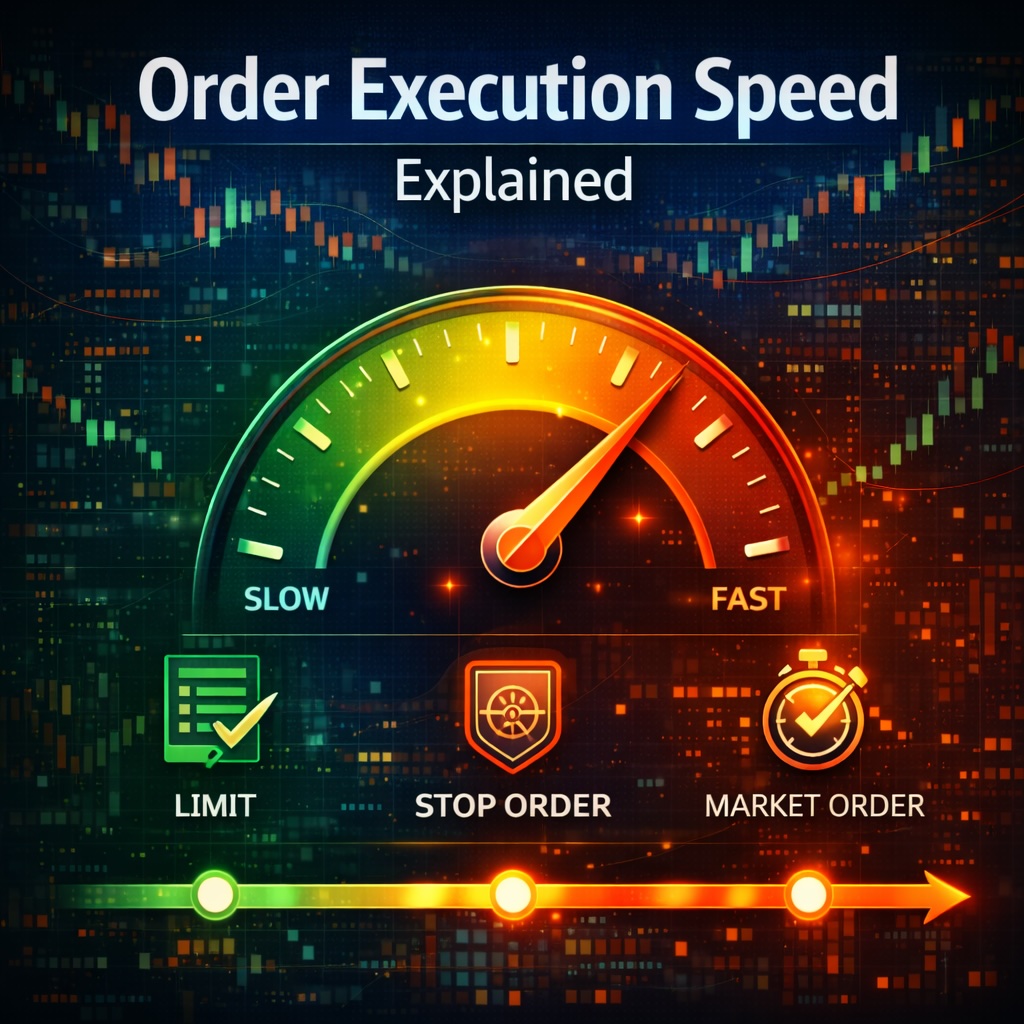
Order execution speed is one of the most underrated variables in trading performance. Many traders spend months improving entries, indicators, and risk models, but they ignore how quickly their orders are actually routed and filled. In live markets, the distance between decision and fill can be the difference between a clean trade and a costly one. If your strategy depends on precision, execution latency is not a technical detail—it is part of your edge. For context, see what is slippage in trading.
In practical terms, execution speed is the time between submitting an order and receiving a confirmed fill. That sounds simple, but inside that window many things happen: platform processing, broker routing, bridge logic, venue matching, and return confirmation. In quiet markets this chain may feel invisible. In fast markets it becomes painfully visible through slippage, missed fills, and inconsistent outcomes. A useful companion topic is stop-loss order.
This is why professional traders treat execution like a measurable performance component. They do not only ask, “Was my setup right?” They also ask, “How fast and how well was I filled?” In this guide, we break down what execution speed means, why it matters for real P&L, what affects it, and how the impact differs across trading styles. You can compare this with smart order routing.
- What Is Execution Speed?
- Why order execution speed matters (slippage, fills, arbitrage)
- Factors Affecting Speed (broker, server, internet)
- Impact on Different Styles (scalping vs swing)
- How to Measure and Improve Execution Speed
- Execution Benchmarks Traders Can Use
- Common Mistakes That Hide Execution Problems
- Key Takeaways
- FAQ
- How can I check my broker’s execution speed?
- Does VPS improve execution speed?
- Is fast execution always better?
- Can execution speed vary by market session?
- What matters more: average speed or worst-case events?
What Is Execution Speed?
Execution speed is typically measured in milliseconds and represents order transit plus matching time. You click buy or sell, and the order enters a processing path. Your terminal sends data to broker infrastructure, the broker routes to one or more liquidity venues, and matching happens where counterparties exist. After that, the platform receives a fill report. Every stage introduces potential delay. For a deeper execution angle, review partial fills.
It is useful to separate two concepts: latency and execution quality. Latency is speed. Execution quality includes speed plus price outcome, fill probability, and consistency under stress. A very fast system can still deliver poor fills if routing logic is weak. A slightly slower system can deliver better all-in results if routing quality is strong. Good traders evaluate both. Related concept: Time in Force.
Another key point: average speed is not enough. You need distribution data—median, percentiles, and tail events. A broker may advertise excellent average timing, but your strategy can still suffer if the worst 5% of fills are extremely slow during volatility spikes. Tail behavior often matters more than headline averages for risk-heavy systems.
Execution speed also varies by instrument and session. The same broker can show different practical outcomes on major forex pairs versus small-cap equities, or during London/New York overlap versus quieter hours. Traders who assume one global number for all instruments often underestimate their true execution risk.
Why order execution speed matters (slippage, fills, arbitrage)
Why execution speed matters becomes obvious when markets move quickly. If your order reaches the book later than expected, your intended price may no longer exist. The result is slippage. For momentum entries, slow fills can force buying higher or selling lower than planned. For exit logic, delay can increase realized loss before protection triggers.
Fill probability is another direct effect. In thin or contested price levels, a delay of even small duration can push your order back in queue priority. This can convert a full fill into a partial fill or no fill at all. For strategies that depend on immediate participation at specific levels, that difference changes expectancy meaningfully.
Arbitrage and spread strategies are even more sensitive. Their edge often exists only for a short window. If routing latency is too high, the spread collapses before both legs execute, and the opportunity disappears or reverses. In that context, fast execution trading is not a luxury; it is a structural requirement for viability.
Execution speed also impacts psychology. Traders with delayed fills often start chasing entries to “catch up,” which worsens discipline and increases cost. Reliable speed reduces this behavioral pressure by making outcomes more predictable. Predictability supports better process adherence and cleaner post-trade analysis.
A practical takeaway is that execution must be included in strategy design. If a system only works under idealized instant fills, it may fail in production. Robust systems survive realistic latency and slippage assumptions across different market states.
Factors Affecting Speed (broker, server, internet)
Broker infrastructure is usually the largest lever. Routing architecture, liquidity relationships, matching path complexity, and bridge stability all affect round-trip time. Two brokers can offer similar spreads yet deliver very different execution behavior under stress. This is why serious broker evaluation requires live sample data, not only marketing specs.
Server location matters because physical distance adds delay. If your trading environment is far from broker or exchange servers, each request travels farther, increasing latency. For short-horizon strategies, even moderate extra distance can degrade outcomes. Hosting near key infrastructure often improves consistency.
Internet quality is important but commonly misunderstood. Raw bandwidth is less critical than stability and jitter. A stable connection with low variance can outperform a high-bandwidth connection with intermittent spikes. Packet loss and route instability can create irregular delays that are hard to diagnose if you only look at average speed tests.
Platform and device load also contribute. If your local machine is overloaded, order processing and interface response can lag before orders even leave your environment. Similarly, heavy plugin stacks or unstable add-ons can add milliseconds in unexpected places.
Market-state effects should not be ignored. During high-impact events, venue-side matching pressure rises and available liquidity can be canceled quickly. Even strong infrastructure may show slower practical outcomes in these windows. The goal is not to expect perfect speed at all times, but to know how your setup behaves across regimes.
To improve this layer, traders should monitor timestamped logs: order send time, acknowledgment time, fill time, requested price, and actual fill. Over time, this reveals where delay and cost concentrate—by instrument, session, and broker path.
Impact on Different Styles (scalping vs swing)
Scalping and ultra-short-term trading: These styles are highly sensitive to milliseconds because target size is small and trade duration is short. A small execution delay can consume a large share of expected profit. For scalpers, poor latency control can turn a statistically valid setup into a negative one, even if directional calls remain good.
Day trading: Day traders are moderately sensitive. Execution speed still matters for breakouts, fades, and stop management, but the impact can vary by setup. A day trader using wider targets may tolerate more delay than a scalper, yet still suffers if entries are repeatedly late during volatile moves.
Swing trading: Swing traders are less sensitive to micro-latency in calm conditions, because trade horizons are longer and target distances are wider. However, execution quality still matters at key moments—gap opens, high-impact releases, and stop events. Poor fills at those moments can materially alter risk-to-reward.
Position trading: Long-horizon traders may consider speed irrelevant, but this is only partly true. While day-to-day latency impact is lower, execution around entry scale-ins, exits, or event-driven rebalancing still affects total cost. Over many large transactions, small execution inefficiencies accumulate.
The practical rule is simple: the shorter your holding period and the tighter your target, the more execution speed matters. But every style benefits from consistent fills, transparent reports, and realistic assumptions in performance attribution.
How to Measure and Improve Execution Speed
Start with measurement, not assumptions. Log every order with timestamp fields: submit, acknowledge, fill, and cancel/modify where relevant. Add requested price, fill price, spread snapshot, and volatility tag. This lets you separate strategy quality from execution quality in a way that supports objective improvement.
Compare broker paths under similar conditions. Do not rely on one day or one instrument. Use enough sample size to evaluate medians, tails, and session behavior. A broker with slightly slower median but tighter tail risk may be better for consistency-focused systems than a broker with flashy median but unstable stress behavior.
If your style is latency-sensitive, consider infrastructure upgrades: stable wired connection, lean trading environment, and optionally VPS placement near broker/exchange infrastructure. Keep software stack minimal and monitor system load before high-impact sessions.
Finally, integrate execution assumptions into your strategy testing. Include slippage and delay scenarios in forward validation. If the strategy remains robust under realistic execution friction, you can deploy with confidence. If it fails, the issue is not bad luck; the model is not production-ready yet.
Execution Benchmarks Traders Can Use
To make this operational, define benchmark ranges for your own system. For example, set acceptable median latency, acceptable 95th percentile latency, and maximum tolerated slippage by setup type. Then review weekly. If one metric drifts, investigate before increasing size. This approach prevents silent performance decay.
You can also benchmark by decision class: breakout entries, pullback entries, stop exits, and scale-outs. Different decision classes often have different sensitivity to delay. A setup that tolerates moderate latency on entry may still require very fast protective exits. Segmenting by class gives clearer diagnostics than a single blended metric.
Most importantly, link execution benchmarks to risk controls. If latency or slippage exceeds your threshold, reduce size automatically or pause that setup until conditions normalize. This converts execution monitoring from passive reporting into active risk management.
Common Mistakes That Hide Execution Problems
A frequent mistake is blaming strategy logic for losses that are actually execution-driven. If entries are routinely late, traders often over-optimize indicators instead of fixing routing or timing windows. Another mistake is reviewing only winning sessions. Execution problems are most visible during stress periods, so your analysis must include volatile days, spread expansions, and news-driven conditions.
Many traders also mix manual and automated decisions without separate tracking. This hides where delay originates. Keep execution logs segmented by method, instrument, and session so you can isolate causes. If your data is not segmented, your fixes will be broad, slow, and often ineffective.
Finally, avoid the “single number” trap. One average latency figure cannot describe real execution behavior. Use medians, tails, and context tags. Better measurement creates better control, and better control protects strategy edge over time.
Key Takeaways
- Order execution speed is a core performance variable, not a technical side note.
- Speed impacts slippage, fill probability, and strategy viability in fast markets.
- Evaluate execution with distribution data, especially tail behavior under stress.
- Broker routing, server distance, and connection stability strongly influence outcomes.
- The shorter your trading horizon, the more execution speed affects your edge.
FAQ
How can I check my broker’s execution speed?
Track timestamped order logs (submit, acknowledge, fill) and compare requested versus executed prices across a large sample.
Does VPS improve execution speed?
Often yes, especially when the VPS is located close to broker or exchange infrastructure and your strategy is latency-sensitive.
Is fast execution always better?
Speed helps, but execution quality also depends on routing logic, liquidity access, and fill consistency under volatile conditions.
Can execution speed vary by market session?
Yes. Liquidity and infrastructure load change by session, which can alter practical fills and latency behavior.
What matters more: average speed or worst-case events?
Both matter, but tail events are often more important for risk, because they can dominate slippage and drawdown during stress periods.