When most beginners learn about orders, they focus on type: market, limit, stop-loss, take-profit. But there is another setting that can change the outcome of a trade just as much: time in force. For context, see limit order.
Time in force determines how long your order stays active and what must happen for it to execute. In some cases it’s the difference between getting filled immediately, getting partially filled, or not trading at all. A useful companion topic is market order vs limit order.
This guide explains time in force orders in simple terms, including the three common instructions: GTC (Good ’Til Canceled), IOC (Immediate or Cancel), and FOK (Fill or Kill). You’ll also learn when each makes sense and what mistakes to avoid. You can compare this with partial fill in trading.
- What Is Time in Force?
- Why time in force matters
- GTC (Good ’Til Canceled)
- How GTC works
- When GTC is useful
- GTC risks and common mistakes
- IOC (Immediate or Cancel)
- How IOC works
- When IOC is useful
- IOC risks and trade-offs
- FOK (Fill or Kill)
- How FOK works
- When FOK is useful
- FOK risks and trade-offs
- How Time in Force Interacts With Order Types
- Limit orders + GTC
- Limit orders + IOC
- Limit orders + FOK
- Market orders and TIF
- Which to Use When?
- Choose GTC when:
- Choose IOC when:
- Choose FOK when:
- Common Time-in-Force Mistakes (and How to Avoid Them)
- GTD vs Day vs GTC (Quick Differences)
- Quick note: Day orders and other TIF options
- Mini Scenario: Choosing the Right TIF
- Key Takeaways
- FAQ
- What does time in force mean in trading?
- What is the difference between GTC and IOC?
- Do brokers support all time-in-force types?
- Is FOK better than IOC?
What Is Time in Force?
Time in force is an order instruction that tells the market how long your order should remain active and under what execution conditions it should be filled. For a deeper execution angle, review slippage in trading.
Think of it like this: Related concept: smart order routing.
- An order type (market/limit/stop) answers: “At what price should I trade?”
- Time in force answers: “For how long, and with what execution requirement?”
Different markets and venues support different time-in-force options. The names can vary, but the logic is consistent: TIF controls the lifetime of the order and sometimes the fill behavior.
Why time in force matters
Time in force matters because it affects:
- Fill probability: does your order remain waiting or expire quickly?
- Exposure to price changes: an order that stays active can fill later when the market conditions have changed.
- Partial fills: some TIF settings allow partial execution; others explicitly prevent it.
- Operational risk: forgetting a long-lived order can create unwanted trades later.
Even if you’re trading “simple” strategies, understanding TIF helps you avoid accidental mistakes—like leaving a limit order active for days when you intended it to be valid only for the current session.
GTC (Good ’Til Canceled)
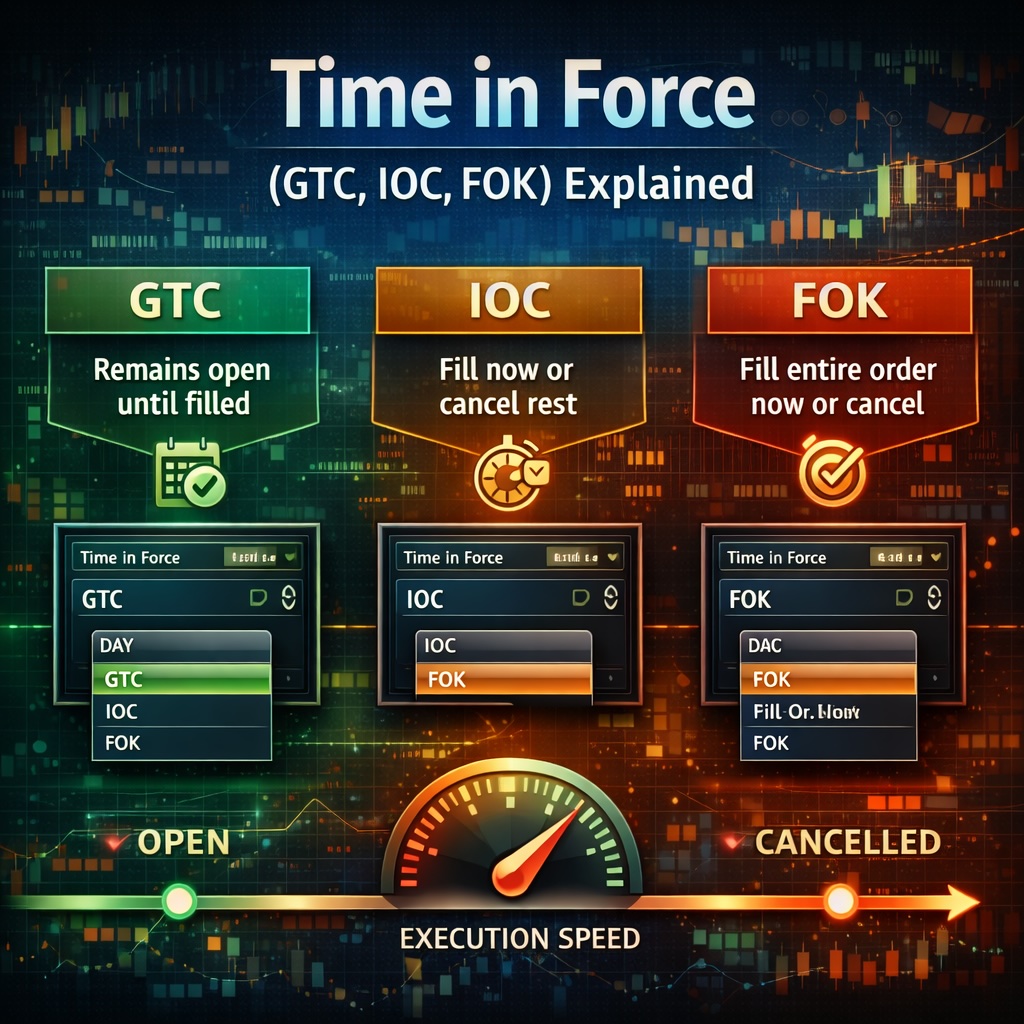
GTC stands for Good ’Til Canceled. A GTC order remains active until it is filled or you manually cancel it (or it expires due to a broker/venue rule).
How GTC works
- You place an order (often a limit order) with TIF = GTC.
- The order stays in the system across sessions.
- It can fill at any time in the future when the market reaches your price.
GTC is popular for “set-and-wait” trading. If you have a planned level and you are willing to wait days for price to reach it, GTC can make sense.
When GTC is useful
- Swing trading entries: you want to buy or sell at a specific level without watching the market all day.
- Planned profit targets: you place take-profit limits and let them sit.
- Longer timeframes: your setup may take time to develop.
GTC risks and common mistakes
- Forgetting the order exists: the market can revisit your price days later and trigger an entry you no longer want.
- Changing context: the reason for the trade may no longer be valid when the order eventually fills.
- Hidden exposure: multiple GTC orders can create unintended total risk if several fill around the same time.
Practical habit: if you use GTC, review your open orders daily (or on a fixed schedule) to ensure they still match your plan.
IOC (Immediate or Cancel)
IOC stands for Immediate or Cancel. An IOC order instructs the market to execute as much as possible immediately, and cancel any unfilled portion.
How IOC works
- You submit an order with TIF = IOC.
- The system attempts to fill it immediately.
- If the full size cannot be filled right away, the remaining portion is canceled.
IOC is often used when you want speed but you don’t want a leftover order sitting in the market book. It is a way to “take what you can now” without leaving a footprint.
When IOC is useful
- Liquidity-sensitive execution: you want to avoid being exposed as a resting order.
- Large orders split into pieces: you prefer partial fills now rather than waiting.
- Fast decision context: you want to participate immediately, but only in the current moment.
IOC risks and trade-offs
- Unexpected partial fills: you may end up with a smaller position than planned.
- More complex risk control: partial size means your stop-loss and take-profit sizing may need adjustment.
- Not always available: some venues don’t offer IOC for all instruments or account types.
FOK (Fill or Kill)
FOK stands for Fill or Kill. A FOK order instructs the market to either fill the entire order immediately or cancel it completely.
How FOK works
- You submit an order with TIF = FOK.
- The system checks whether the entire size can be filled right away.
- If yes, it executes the full size.
- If not, the order is canceled (killed) with no partial execution.
FOK is essentially the opposite of “I’ll take partial.” It is “all or nothing.”
When FOK is useful
- You need the full size: partial execution would break your plan.
- You are executing a precise structure: where incomplete fills create imbalance.
- You want to avoid leftover exposure: no partial position should remain.
FOK risks and trade-offs
- Higher chance of no trade: if liquidity is not deep enough, you may not fill at all.
- Opportunity cost: the market can move away while your FOK is repeatedly rejected.
- Not always supported: availability depends on the venue.
How Time in Force Interacts With Order Types
Time in force becomes more intuitive when you connect it to order types you already know.
Limit orders + GTC
This is a classic combination: you place a limit at a planned price and keep it active until the market reaches it. It’s convenient, but it also increases the chance you forget the order and get filled later when your original idea is no longer valid.
Limit orders + IOC
With IOC, you’re asking: “Fill me immediately at my limit price (or better) for as much size as possible, and cancel the rest.” This is useful when you want to participate now but don’t want a resting order sitting in the book. The outcome may be partial execution.
Limit orders + FOK
This says: “Fill my entire size immediately at my limit price (or better), or don’t fill me at all.” FOK can reduce the operational mess of partial fills, but it increases the likelihood of no trade.
Market orders and TIF
Market orders are generally designed to execute immediately, so some venues treat time-in-force as irrelevant for pure market orders. However, execution instructions still matter—especially when you use market-like logic triggered by other conditions (for example, a stop order becoming a market order).
Which to Use When?
Here’s a simple framework to choose between GTC, IOC, and FOK.
Choose GTC when:
- You are comfortable waiting for your price.
- You want the order to remain active across sessions.
- Your strategy is not dependent on immediate execution.
Choose IOC when:
- You want immediate execution, but you’re okay with partial size.
- You don’t want any unfilled remainder sitting as a resting order.
- You want “participation now” without long-lived exposure.
Choose FOK when:
- You need the full size immediately or you don’t want the trade at all.
- Partial fills would create operational or risk problems.
- You are trading in a liquid environment where full fills are realistic.
Common Time-in-Force Mistakes (and How to Avoid Them)
- Leaving GTC orders unattended: If you use GTC, review open orders on a schedule. If the setup is no longer valid, cancel the order.
- Assuming IOC will fill your intended size: IOC can produce partial fills. Plan for what you do if you get only a small position.
- Using FOK in low liquidity: If the market cannot fill your full size immediately, you’ll get no trade and may miss the move.
- Not matching order duration to timeframe: Intraday ideas often fit “day” duration better than GTC. Longer-term ideas may fit GTC or GTD.
- Confusing order type with time in force: “Limit” controls price; TIF controls duration and fill conditions. You typically choose both.
GTD vs Day vs GTC (Quick Differences)
- Day: expires at the end of the trading session/day. Useful when you only want the order valid today.
- GTD (Good ’Til Date): stays active until a specific date/time you choose. Useful when you want a longer window, but not unlimited duration.
- GTC: stays active until you cancel it (or the venue expires it). Useful for longer-term “set-and-wait” plans, but easiest to forget.
Even if your platform hides these labels, the core idea is the same: match order duration to your timeframe so you don’t get accidental fills later.
Quick note: Day orders and other TIF options
Some venues also offer time-in-force instructions like “Day” (expires at end of session/day) or “GTD” (Good ’Til Date). Even if your platform doesn’t show them explicitly, the same principle applies: TIF controls duration and fill behavior.
Mini Scenario: Choosing the Right TIF
Here’s a practical way to think about TIF without overcomplicating it. Suppose you have a planned entry level and you’re deciding how you want the order to behave:
- “I’m fine waiting days for my level.” → GTC
- “I only want what’s available right now; don’t leave anything resting.” → IOC
- “I need the full size now or I don’t want the trade.” → FOK
The order type (market/limit/stop) defines the price logic. Time in force defines the execution logic over time.
Key Takeaways
- Time in force determines how long an order stays active and how it should be executed.
- GTC stays active until canceled (or expired by a venue rule).
- IOC fills immediately as much as possible and cancels the rest.
- FOK must fill completely immediately or it is canceled.
- The best choice depends on whether you prioritize waiting, partial fills, or all-or-nothing execution.
FAQ
What does time in force mean in trading?
Time in force is an order instruction that defines how long your order remains active and what execution conditions apply. It controls whether an order can wait, must fill immediately, or must fill fully.
What is the difference between GTC and IOC?
GTC stays active until it’s filled or you cancel it, while IOC attempts to fill immediately and cancels any unfilled portion right away.
Do brokers support all time-in-force types?
Not always. Time-in-force options depend on the market, instrument, and platform. Some venues offer only basic options, while others support advanced instructions like IOC and FOK.
Is FOK better than IOC?
Neither is “better” universally. IOC is useful when partial fills are acceptable. FOK is useful when you need the full size immediately and partial execution would break your plan.