If you’ve ever hesitated before clicking “Buy” because you didn’t like the price on your screen, you already understand the idea behind a limit order. A limit order lets you trade with rules instead of impulses: you decide the price you’re willing to accept, and the market either reaches it or it doesn’t. For context, see market order vs limit order.
This guide explains what a limit order is, how it works step by step, the difference between buy limit vs sell limit orders, and when limit orders make sense (and when they can quietly hurt you). You’ll also see practical examples and common mistakes beginners make when they first switch from market orders to limit orders. A useful companion topic is stop-loss order.
- Definition
- How Limit Orders Work
- Buy limit vs sell limit (the simple rule)
- What happens after you place a limit order?
- Examples in Forex & Stocks
- Stock example (buy limit)
- Stock example (sell limit)
- Forex example (buy limit vs sell limit)
- Limit order trading example (a realistic workflow)
- Benefits (Price Control, Reduced Slippage)
- 1) Price control (you choose the deal)
- 2) Reduced slippage (especially in fast markets)
- 3) Cleaner planning and less emotion
- Limit Order vs Stop Order (Don’t Confuse Them)
- Drawbacks (No Execution Guarantee)
- 1) No execution guarantee
- 2) Partial fills can happen
- 3) You can still lose opportunities during high momentum
- 4) You can get filled and immediately be wrong
- Key Takeaways
- FAQ
- What is the difference between a buy limit and a sell limit order?
- Do limit orders cost more fees?
- Can a limit order execute at a better price?
- Can a limit order reduce slippage?
Definition
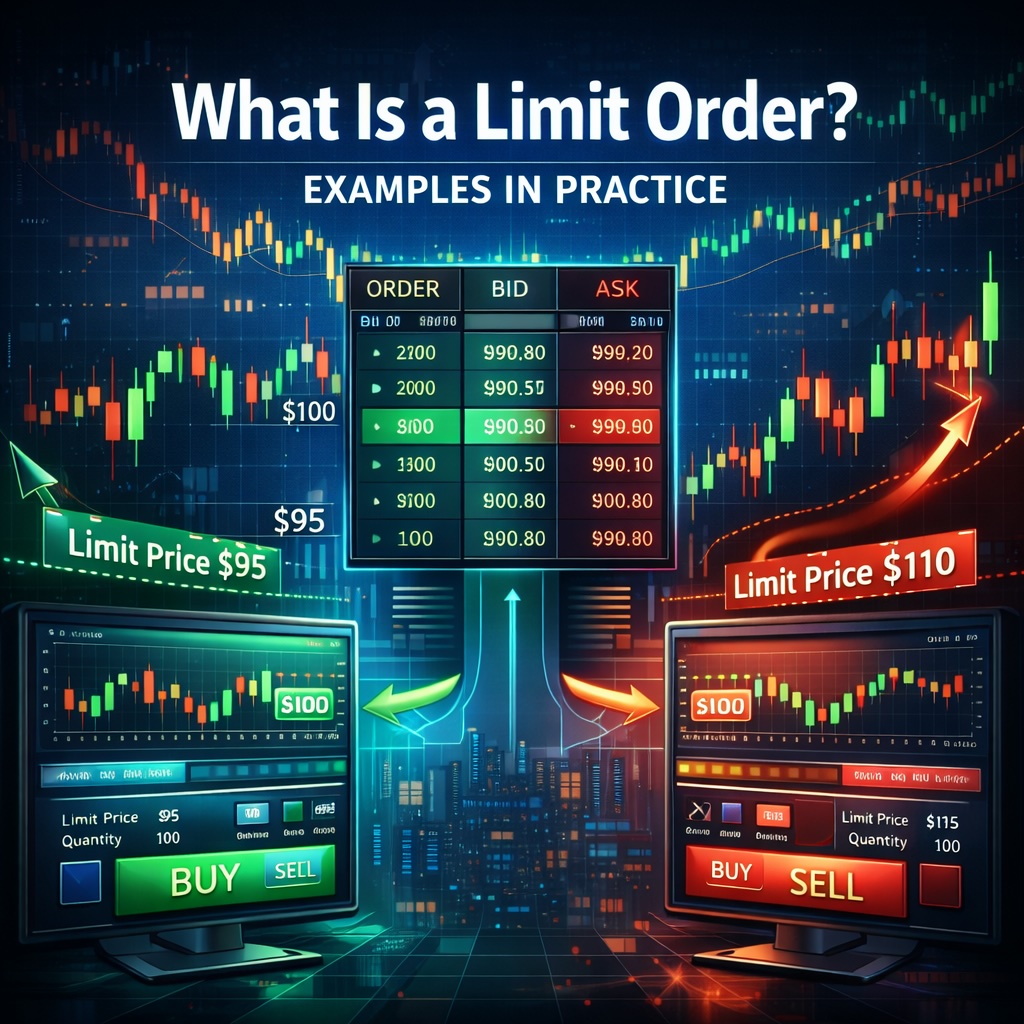
A limit order is an instruction to buy or sell an asset at a specific price (or better). You can compare this with take-profit order.
- Buy limit: you want to buy at your limit price or lower.
- Sell limit: you want to sell at your limit price or higher.
That “or better” part matters. It means the order is price-protected, but it is not execution-protected. In other words: you control the price, but you do not control whether you get filled. For a deeper execution angle, review Time in Force (GTC, IOC, FOK).
How Limit Orders Work
Limit orders sit in the market’s order book (or your broker’s internal order system) waiting for someone on the other side to trade with you at your chosen price. When the market reaches that price, the order can be executed—fully, partially, or not at all—depending on liquidity and available volume. Related concept: what is slippage in trading.
Here’s the mental model that helps most beginners:
- A market order says: “Do it now, at the best available price.”
- A limit order says: “Only do it if you can give me this price or better.”
Buy limit vs sell limit (the simple rule)
A quick rule of thumb:
- Buy limit is typically placed below the current market price.
- Sell limit is typically placed above the current market price.
Why? Because a buy limit is usually used to “wait for a better deal” (a lower price), and a sell limit is used to “wait for a better sale” (a higher price). There are exceptions in certain advanced setups, but for most traders, this is the baseline.
What happens after you place a limit order?
- You choose a limit price and submit the order.
- The order becomes active according to its time-in-force setting (for example: day order or good-til-canceled).
- The market trades. If the market reaches your price, the order becomes eligible to fill.
- The fill happens (or doesn’t) depending on available liquidity and matching rules.
- If not filled, the order remains pending until it expires, is canceled, or is triggered and filled later.
Examples in Forex & Stocks
Because markets use slightly different mechanics, it helps to see limit order examples in more than one context. The core idea stays the same: you set a price, and the trade only happens at that price or better.
Stock example (buy limit)
Imagine a stock is trading around $50.10. You believe $49.50 is a better entry because that’s where the price previously bounced.
- You place a buy limit at $49.50 for 100 shares.
- If the price drops and trades at $49.50, your order can execute.
- If the price never touches $49.50, you won’t buy any shares.
What does “or better” mean here? If the market suddenly gaps down and there are sellers at $49.30, your limit buy can fill at $49.30 (better than $49.50). That’s the best-case scenario: you get a better entry than you asked for.
Stock example (sell limit)
Now suppose you already own 100 shares. You want to lock profits if price reaches $55.00.
- You place a sell limit at $55.00.
- If the market trades at $55.00 or higher and there’s enough demand, you can sell at $55.00 (or higher).
- If it stalls at $54.99 and reverses, you might never get filled.
This illustrates the biggest psychological “trap” with limit orders: being almost right is the same as being wrong. If your price is never reached, there is no trade.
Forex example (buy limit vs sell limit)
In FX quotes, you’ll see two prices: bid (sell) and ask (buy). That matters because your order fills against the opposite side.
Suppose a major currency pair is quoted around 1.1000. You want to:
- Buy lower at 1.0950 → place a buy limit at 1.0950.
- Sell higher at 1.1050 → place a sell limit at 1.1050.
If the market moves quickly, you might get filled at your level and then see price snap back. That’s not a limit-order problem—it’s a strategy/entry problem. The limit order simply enforced your “only at this price” rule.
Limit order trading example (a realistic workflow)
Here’s a common beginner-friendly workflow that shows how limit orders create structure:
- You identify a level where you’d like to enter (support/resistance, pullback zone, value area).
- You decide a price that makes the trade “worth it.”
- You place a limit order and walk away—no chasing.
- If it fills, you manage the position. If it doesn’t, you reassess without emotional damage.
This is one reason limit orders are often used to reduce impulsive trading. They can act like a safety rail: you can’t accidentally buy a spike at an uncomfortable price if you never gave permission to do so.
Benefits (Price Control, Reduced Slippage)
Limit orders are popular for three main reasons: price control, improved discipline, and reduced exposure to slippage.
1) Price control (you choose the deal)
A limit order forces the market to meet your terms. This matters most when prices move quickly or when the asset is less liquid. With a market order, you accept whatever is available. With a limit order, you set the maximum you’ll pay (buy) or the minimum you’ll accept (sell).
2) Reduced slippage (especially in fast markets)
Slippage is the difference between the price you expect and the price you actually get filled at. Limit orders can reduce negative slippage because you’re not asking to be filled “right now at any price.”
Important nuance: limit orders reduce price uncertainty, but they can increase fill uncertainty. That trade-off is the entire point.
3) Cleaner planning and less emotion
Limit orders naturally pair with pre-planned setups. If you can’t define a price you’re comfortable trading, that’s often a signal you’re reacting rather than planning. Beginners who switch to limit orders often report fewer “regret entries” because they stop chasing.
Limit Order vs Stop Order (Don’t Confuse Them)
A common beginner mistake is mixing up limit orders and stop orders. They sound similar, but they’re built for different jobs.
- Limit order: executes at a specific price or better. It’s used to control price.
- Stop order: activates when price reaches a trigger level. It’s often used to manage risk (stop-loss) or to enter momentum moves.
Simple rule: a limit order is typically used to buy lower or sell higher. A stop order is typically used to buy higher or sell lower after price has moved to a trigger.
Drawbacks (No Execution Guarantee)
The biggest downside of limit orders is simple: you might not get the trade.
1) No execution guarantee
If the market never reaches your price, your order never fills. That can be frustrating if you were correct about the overall direction but too strict on the entry.
In practice, this usually shows up as:
- Price comes close, misses your level by a small amount, then runs away.
- You keep “improving” your entry and end up missing the entire move.
2) Partial fills can happen
Depending on the market and order size, your limit order can be partially filled. That means you intended to buy/sell a certain quantity, but only part of it executed at your limit price. You may end up with a smaller position than planned, which can affect risk management and position sizing.
3) You can still lose opportunities during high momentum
In strongly trending markets, waiting for “the perfect price” can be expensive. Limit orders reward patience, but they can punish unrealistic expectations—especially if you anchor to a price that no longer makes sense given new volatility.
4) You can get filled and immediately be wrong
Beginners sometimes assume: “If my limit order filled, that means I got a good price.” Not necessarily. A limit order can fill because the market is moving against you. Your order might be the liquidity that others are hitting on the way down (for buys) or on the way up (for sells). The order doesn’t validate the trade—it only controls the price.
Key Takeaways
- A limit order buys or sells at a specified price or better.
- Buy limit orders fill at your limit price or lower; sell limit orders fill at your limit price or higher.
- Limit orders give price control and can reduce negative slippage, but there is no execution guarantee.
- You may miss trades if the market never reaches your level—or if your level is too strict.
- In some cases, partial fills are possible and can change your planned position size.
FAQ
What is the difference between a buy limit and a sell limit order?
A buy limit is placed to buy at a chosen price or lower, typically below the current market price. A sell limit is placed to sell at a chosen price or higher, typically above the current market price.
Do limit orders cost more fees?
Usually, the order type itself doesn’t add extra fees. Fees depend on your broker’s pricing model and the market you trade. However, in some venues, different order types can receive different pricing or rebates—so it’s best to check your specific fee schedule.
Can a limit order execute at a better price?
Yes. Because a limit order is “at your price or better,” it can sometimes fill at a more favorable price if liquidity is available. For example, a buy limit can fill below your limit price.
Can a limit order reduce slippage?
Yes. A limit order protects the price you’re willing to accept, which can reduce negative slippage. The trade-off is that the order may not fill if the market doesn’t reach your limit price.