A stop-loss order is one of the simplest ideas in trading—and one of the most misunderstood. Beginners often think a stop-loss is just “a line on the chart.” In reality, it’s a decision rule: if price reaches this level, I exit. When used correctly, a stop-loss helps you control downside risk, reduce emotional decision-making, and avoid turning a small mistake into a large loss. For context, see take-profit order.
This beginner’s guide explains what a stop-loss order is, how it works in different markets, the most common stop-loss types (including trailing stops), and the practical pros and cons you should understand before relying on them. A useful companion topic is market order vs limit order.
- Purpose of Stop-Loss
- What Is a Stop-Loss Order?
- How It Works (Examples in Forex and Stocks)
- Example in stocks (long position)
- Example in forex (short position)
- Stop-loss example (why fills can differ from the stop price)
- How to Place a Stop-Loss (Practical Approaches)
- 1) Structure-based stop (invalidation)
- 2) Volatility-based stop (room to breathe)
- 3) Fixed-risk stop (account-based)
- Mental stop vs stop order
- Types of Stop-Loss (Hard Stop, Trailing Stop)
- 1) Hard stop (fixed stop-loss)
- 2) Stop-Market vs Stop-Limit (Important Distinction)
- 3) Trailing stop
- Common Stop-Loss Mistakes (and Fixes)
- Where NOT to place a stop-loss
- Pros & Cons
- Pros
- Cons
- Is Stop-Loss Mandatory in Trading?
- Key Takeaways
- FAQ
- Is stop-loss mandatory in trading?
- What is a trailing stop?
- Should I use a stop-market or stop-limit for risk control?
- Why do stop-loss orders sometimes fill at a worse price?
Purpose of Stop-Loss
The purpose of a stop-loss is not to “prevent losses.” Losses are part of trading. The purpose is to cap a loss at a level you can live with. You can compare this with limit order.
A stop-loss helps you answer three questions before you enter a trade: For a deeper execution angle, review Time in Force rules.
- Where am I wrong? (the invalidation level)
- How much can I lose? (the risk per trade)
- What happens if I’m wrong quickly? (execution and slippage)
In practical terms, stop-losses are a risk management tool. They are not a prediction tool. They don’t improve your win rate by themselves—but they often improve your long-term survival. Related concept: order execution speed.
What Is a Stop-Loss Order?
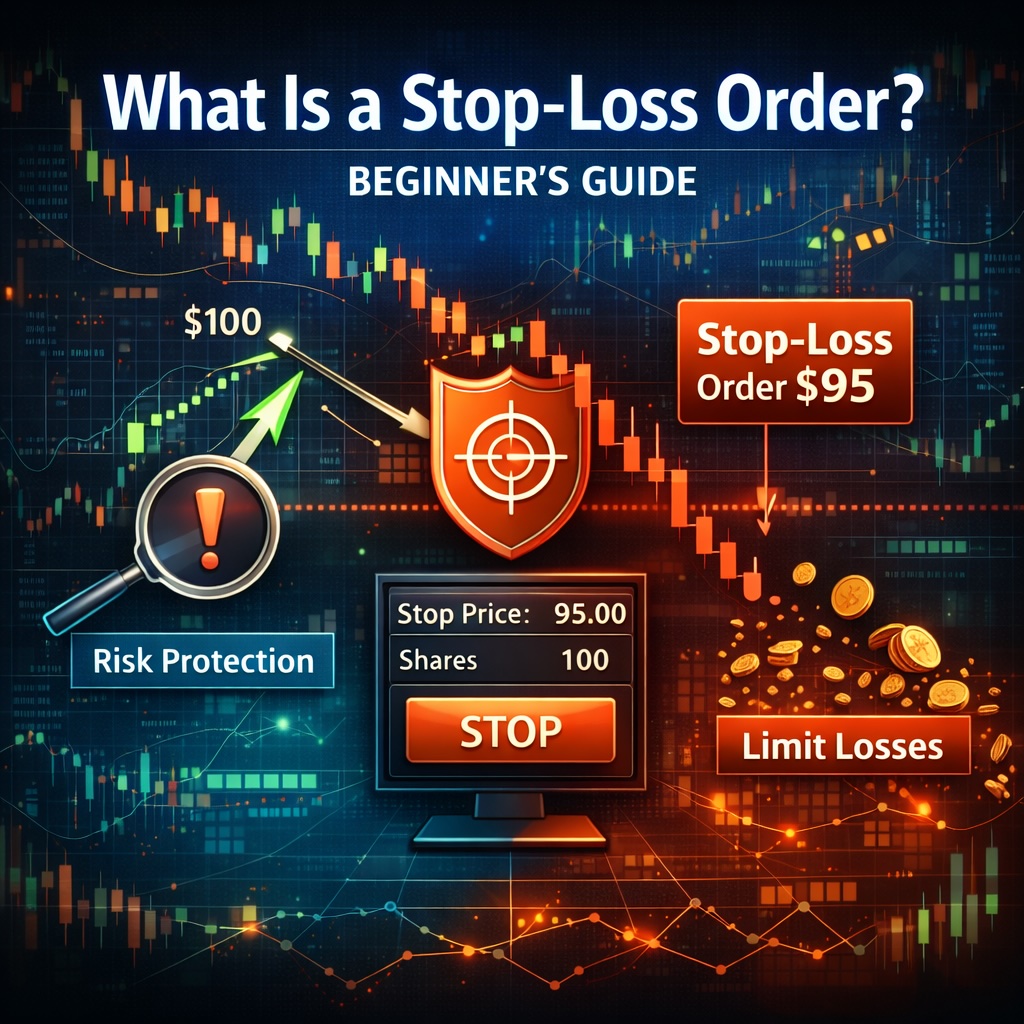
A stop-loss order is an instruction to close a position when price reaches a specified level, aiming to limit further losses.
There are two important details beginners must understand:
- A stop-loss is typically a trigger. Once triggered, it becomes an order to exit.
- Depending on the exact type, the exit may happen at the next available price, which can differ from your stop level (slippage).
Many platforms offer more than one stop-loss “flavor.” The underlying concept stays the same: you predefine the maximum pain you accept and automate the exit.
How It Works (Examples in Forex and Stocks)
Stop-loss mechanics are easiest to understand through examples. The numbers below are simplified so you can focus on the logic rather than market-specific details.
Example in stocks (long position)
Imagine you buy an asset at $100 because you expect it to move higher. You decide that if price drops to $96, the trade idea is invalid.
- Entry: buy at $100
- Stop-loss: $96
- Risk per unit: $4
If price falls to $96, your stop-loss triggers and you exit. You took a controlled loss instead of “hoping it comes back.”
Example in forex (short position)
Now suppose you sell (short) a currency pair at 1.2000. Your invalidation level is 1.2060.
- Entry: sell at 1.2000
- Stop-loss: 1.2060
- If price rises to 1.2060, you exit the short.
Notice the direction logic:
- For a long position, a stop-loss is typically placed below entry.
- For a short position, a stop-loss is typically placed above entry.
Stop-loss example (why fills can differ from the stop price)
Beginners often assume: “If my stop is $96, I will exit at $96.” That’s not always true.
If the market moves fast and trades through $96, your stop may trigger and then fill at $95.70 or $95.20. That difference is called slippage. The stop level is still useful because it defines your rule—just don’t assume perfect execution in all conditions.
How to Place a Stop-Loss (Practical Approaches)
Most stop-loss problems don’t come from the order type—they come from placement. A good stop-loss level is usually tied to a reason the trade idea is invalid, not a random distance from entry.
1) Structure-based stop (invalidation)
This approach places the stop where your setup is clearly wrong—for example, beyond a recent swing high/low, a broken support/resistance area, or a key level that defined your thesis. The advantage is logic: if price reaches that level, your reason for being in the trade is likely invalid.
2) Volatility-based stop (room to breathe)
Markets move in “noise” even when you are right. A volatility-based stop uses the idea that your stop should allow normal fluctuations without triggering. Traders often estimate typical movement using recent ranges and place the stop outside that zone. The goal is not to avoid losses, but to avoid being stopped out by routine movement.
3) Fixed-risk stop (account-based)
Here you start with your maximum acceptable loss per trade (for example, a small percentage of your account) and then calculate position size based on the stop distance. This is more professional than “choose a big size and hope.” It also forces consistency across trades with different volatility.
Key idea: the stop-loss level and the position size are connected. A wider stop with the same position size means more risk. If you widen a stop, you typically need to reduce size to keep risk constant.
Mental stop vs stop order
Some traders choose a “mental stop” (you exit manually if a level breaks). The risk is execution: in a fast move, hesitation and slippage can turn a planned exit into a much worse one. For beginners, a real stop order usually enforces better discipline.
Types of Stop-Loss (Hard Stop, Trailing Stop)
Stop-loss orders come in several forms. Each has a different trade-off between execution certainty and price control.
1) Hard stop (fixed stop-loss)
A hard stop is a fixed stop-loss level that does not move. It is the most common choice for beginners because it is simple and forces discipline.
Typical use cases:
- Chart-based invalidation (support/resistance break)
- Risk-based invalidation (maximum loss per trade)
2) Stop-Market vs Stop-Limit (Important Distinction)
Many markets support two main stop-loss execution modes:
- Stop-market: when the stop level is reached, the stop turns into a market order. This prioritizes getting you out, but the fill price can slip.
- Stop-limit: when the stop level is reached, the stop turns into a limit order. This protects price, but it can fail to execute if the market moves too fast.
For pure risk control, many traders prefer stop-market logic because the priority is exiting the position, not negotiating the price. For very illiquid conditions, you must understand the risk of either approach.
3) Trailing stop
A trailing stop is a stop-loss that moves in your favor as price moves in your favor. It “trails” behind the market by a chosen distance (percentage or fixed amount). If price reverses enough to hit the trailing stop, you exit.
Simple idea:
- If price goes up (for a long), the trailing stop moves up with it.
- If price goes down, the trailing stop does not move down—it stays where it is.
Trailing stops can help lock in gains while still giving the trade room to breathe. They can also stop you out too early if the trailing distance is too tight for the asset’s volatility.
Common Stop-Loss Mistakes (and Fixes)
- Placing stops where everyone places them without a reason: Instead of copying a “standard” distance, tie the stop to invalidation (what would prove you wrong?).
- Putting the stop too tight for the asset’s volatility: If you are stopped out repeatedly by normal movement, your stop is probably inside noise. Either widen it (and reduce size) or trade a different setup/timeframe.
- Moving the stop farther away to avoid taking a loss: This turns a small planned loss into an unplanned one. If you move a stop, it should be because the trade structure changed, not because you feel discomfort.
- Relying on stop-limit for protection without understanding the “no fill” risk: A stop-limit can fail in a fast move, leaving you exposed while price continues against you.
- Ignoring gaps: In some markets, price can jump over your stop level. A stop-loss is a tool, not a guarantee of the exact exit price.
Where NOT to place a stop-loss
Many beginners place stops at obvious “round numbers” or at the most visible recent swing point without considering volatility and liquidity. If your stop is placed in a spot where price routinely wicks during normal movement, you increase the chance of getting stopped out even when your overall idea is right. A better approach is to place the stop beyond invalidation and size the position so the risk stays controlled.
Pros & Cons
Pros
- Risk control: a stop-loss limits how much one trade can hurt you.
- Less emotion: you predefine your exit instead of panicking in real time.
- Consistency: stops make it easier to compare trades and measure performance.
- Protection from “small becomes big”: prevents holding losers indefinitely.
Cons
- Stops can be hit by normal volatility: a stop placed too tight can trigger frequently.
- Slippage risk: the final fill can be worse than the stop level in fast markets.
- Stop hunting myths and poor placement: focusing on “avoid being hunted” can lead to irrational stop placement.
- False sense of safety: a stop-loss is not a guarantee in every scenario; gaps and rapid moves can still create larger-than-expected losses.
Is Stop-Loss Mandatory in Trading?
Stop-loss is not legally mandatory, but for most beginners it is practically mandatory if you want consistent risk control. Even if you do not use a stop order, you still need a stop-loss decision: a clear point where you exit if you are wrong.
The most important habit is not the tool itself—it’s the discipline of defining risk before entry.
Key Takeaways
- A stop-loss order is a predefined exit designed to limit losses if price moves against you.
- Stops protect your account by capping risk on individual trades.
- Stop-market prioritizes getting out; stop-limit prioritizes price control (with a risk of no fill).
- Trailing stops move in your favor as price moves in your favor, helping protect gains.
- Stop-loss is not a guarantee—slippage and gaps can still occur in fast conditions.
FAQ
Is stop-loss mandatory in trading?
It’s not mandatory, but it’s strongly recommended for most beginners because it creates consistent risk limits. Even without a stop order, you should have a clear level where you exit if you are wrong.
What is a trailing stop?
A trailing stop is a stop-loss that automatically moves in your favor as price moves in your favor. If price reverses enough to hit the trailing level, it triggers an exit.
Should I use a stop-market or stop-limit for risk control?
For pure risk control, stop-market logic is often preferred because it prioritizes execution. Stop-limit can protect price but may fail to fill during fast moves.
Why do stop-loss orders sometimes fill at a worse price?
Because the market can move quickly through your stop level. When the stop triggers, the available liquidity may be at worse prices, causing slippage.