A take-profit order is the “other half” of risk management. If a stop-loss defines how much you’re willing to lose when you’re wrong, a take-profit defines how you lock in gains when you’re right. It’s simple in concept: you choose a price level where you want to exit with profit, and you let the order do the job without second-guessing. For context, see stop-loss order.
This article explains what a take-profit order is, how it works in practice, when it helps (and when it can hurt), and how to use take-profit orders in a way that supports discipline instead of forcing rigid exits. A useful companion topic is limit order.
- What Is a Take-Profit Order?
- How Take-Profit Works
- Take-profit vs “closing manually”
- TP + SL = A Complete Trade Plan (Simple Framework)
- Example in Forex & Stocks
- Simple trade plan (Entry + Stop-Loss + Take-Profit)
- Example 1: Take-profit on a long trade
- Example 2: Take-profit on a short trade
- Example 3: Why take-profit orders don’t always guarantee the exact exit
- Advantages (Lock in Profits, Discipline)
- 1) You lock profits without hesitation
- 2) Better discipline and consistency
- 3) Useful for traders who can’t watch the screen
- 4) Helps enforce reward-to-risk planning
- Limitations (Missed Extended Moves)
- 1) A fixed target can cap your upside
- 2) Poorly placed TPs can reduce your edge
- 3) Liquidity and partial fills can matter
- 4) “Set-and-forget” can become complacency
- Common Take-Profit Mistakes (and How to Fix Them)
- How to Use Take-Profit Orders More Effectively
- Use a logical market level
- Use reward-to-risk as a filter (not a religion)
- Consider partial take-profit
- Be aware of time-in-force
- Key Takeaways
- FAQ
- Should I always use a take-profit?
- What’s better: manual close or a take-profit order?
- What is a TP order in trading?
- Can I take profit in parts?
What Is a Take-Profit Order?
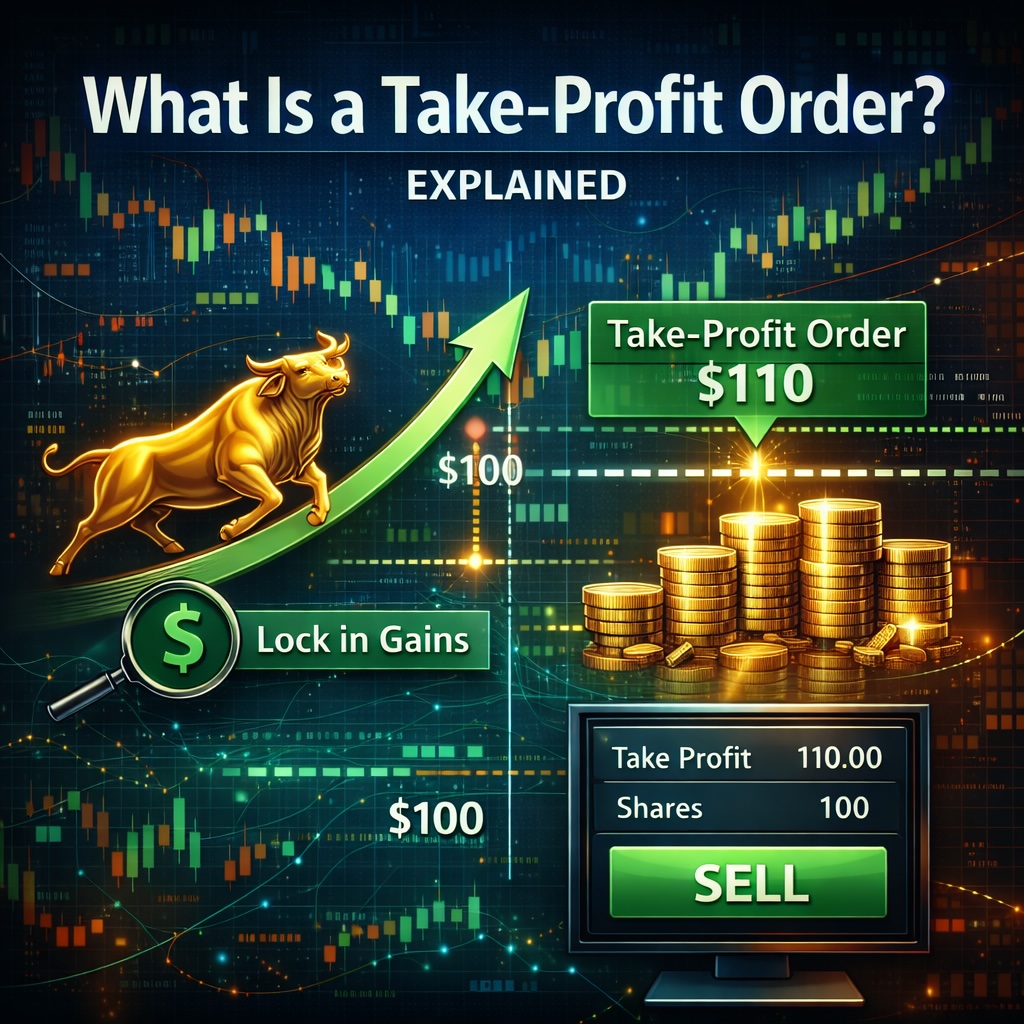
A take-profit order (often abbreviated as TP) is an instruction to close a position automatically once the market reaches a specified profit level. You can compare this with Time in Force.
In most trading setups, a take-profit order is paired with: For a deeper execution angle, review smart order routing.
- an entry (where you open the trade),
- a stop-loss (where you accept being wrong),
- and a take-profit (where you decide the trade is “good enough” and bank the result).
That combination creates a complete plan before emotions kick in. Related concept: execution speed.
How Take-Profit Works
A take-profit order is usually implemented as a limit order that closes your position at a chosen price (or better). Conceptually:
- If you’re long (you bought first), your take-profit is typically placed above your entry price.
- If you’re short (you sold first), your take-profit is typically placed below your entry price.
Once price reaches the TP level, your order becomes eligible to fill. Whether it fills instantly, fills partially, or doesn’t fill at all depends on liquidity and how fast the market moves through that area.
Take-profit vs “closing manually”
Both approaches can work. The difference is psychological and operational:
- Manual closing is flexible, but it’s easy to hesitate, get greedy, or close too early out of fear.
- Take-profit orders are less flexible, but they enforce your plan when emotions are loud.
Beginners often benefit from take-profit orders because they prevent the classic pattern: “I was up, I didn’t close, and then it reversed.”
TP + SL = A Complete Trade Plan (Simple Framework)
A take-profit becomes much more powerful when it’s paired with a stop-loss. Together, they define your trade before you enter:
- Stop-loss (SL): where you exit if you are wrong.
- Take-profit (TP): where you exit if the trade works.
This structure prevents the two classic beginner problems: holding losers too long and holding winners with no exit plan.
Example in Forex & Stocks
The logic of a TP order is the same across markets. Here are simplified examples to show the mechanics.
Simple trade plan (Entry + Stop-Loss + Take-Profit)
A clean way to think about a take-profit is as part of a complete trade plan:
- Entry: where you open the position
- Stop-loss: where you exit if the idea is wrong
- Take-profit: where you exit if the move reaches your planned reward
This structure makes outcomes measurable. You’re not guessing mid-trade—you’re executing a plan.
Example 1: Take-profit on a long trade
Assume you buy an asset at $100. Your plan:
- Stop-loss at $96 (risk: $4)
- Take-profit at $112 (reward: $12)
In this example, the trade has a reward-to-risk of 3:1 ($12 potential gain vs $4 potential loss). If price rises to $112, the take-profit triggers your exit and you lock the profit.
Example 2: Take-profit on a short trade
Now assume you sell short at $50. Your plan:
- Stop-loss at $52 (risk: $2)
- Take-profit at $45 (reward: $5)
If the market drops to $45, your TP executes and closes the short position. Again, the main point is that you defined the exit rules in advance.
Example 3: Why take-profit orders don’t always guarantee the exact exit
Many traders assume: “If price touches my take-profit level, I will exit exactly there.” In most cases you will—but there are situations where it’s not perfect:
- Fast markets: price can move quickly through your level. You might get filled, but not necessarily instantly if liquidity is thin.
- Gaps: in some markets, price can jump over levels.
- Partial fills: if your size is large relative to available liquidity, you may not be filled entirely at your target.
In practice, for typical retail-sized orders in liquid conditions, a take-profit behaves predictably. The main risk is not “bad fills”—it’s the strategic question of whether your TP is placed intelligently.
Advantages (Lock in Profits, Discipline)
1) You lock profits without hesitation
The most obvious advantage is mechanical: you exit at your planned target instead of relying on real-time decision-making. This helps avoid giving back gains during reversals.
2) Better discipline and consistency
Take-profit orders support consistency. If you always take profits randomly, it’s difficult to evaluate whether your strategy works. Using predefined exits makes results more comparable across trades.
3) Useful for traders who can’t watch the screen
If you can’t monitor your position constantly, TP orders are practical. They allow you to set the trade and let it resolve according to your plan.
4) Helps enforce reward-to-risk planning
Take-profit orders encourage you to think in probabilities and trade design. Before entering, you can compare the potential reward (TP distance) to the potential risk (stop-loss distance) and decide whether the setup is worth taking.
Limitations (Missed Extended Moves)
1) A fixed target can cap your upside
The biggest limitation of a take-profit order is that it can cut off an extended move. You exit at your target, and then the market continues in your direction.
This can feel frustrating, but it’s not necessarily “bad.” Trading is not about capturing every possible dollar—it’s about executing a repeatable process. The key question is whether your targets are aligned with the market’s behavior and your strategy.
2) Poorly placed TPs can reduce your edge
Taking profit too early can make a strategy unprofitable, even if your entries are good. If your average win is too small compared to your average loss, you need a very high win rate just to break even.
3) Liquidity and partial fills can matter
In some conditions, especially with larger order sizes or thinner markets, your TP may fill partially. That can leave you with a smaller remaining position than intended, or require additional management.
4) “Set-and-forget” can become complacency
Automation is useful, but it does not replace thinking. If new information changes the context of the trade, it may make sense to adjust the plan. The goal is disciplined flexibility—not rigidness.
Common Take-Profit Mistakes (and How to Fix Them)
- Setting TP based on hope instead of structure: If your target has no logic, it’s hard to repeat. Tie targets to levels where the market has reacted before.
- Taking profits too early because you fear losing them: If every winner is tiny, you may need an unrealistic win rate. Consider widening targets or scaling out instead of exiting everything fast.
- Placing a TP so far away it’s rarely hit: A “perfect” target that almost never fills is not helpful. Targets should be realistic relative to volatility and timeframe.
- Ignoring fees and spread effects: Small targets can be eaten by costs. Make sure your average win is large enough to matter after trading costs.
- Changing targets mid-trade without a rule: Moving a TP should be a planned decision (for example, trailing logic), not an emotional reaction.
How to Use Take-Profit Orders More Effectively
There is no single “best” way to set take-profits. However, these approaches tend to be more robust than random targets.
Use a logical market level
Targets often work better when they align with a reason price may react, such as a previous high/low, a range boundary, or a clear area where traders might take profits.
Use reward-to-risk as a filter (not a religion)
Reward-to-risk ratios are helpful, but they aren’t magic. A 3:1 target is pointless if it’s unrealistic for the market’s typical movement. Use reward-to-risk to avoid bad trades—not to force impossible targets.
Consider partial take-profit
Some traders take profit in stages (for example, closing part of the position at the first target and letting the rest run). This can reduce regret: you bank some profit while keeping exposure to a larger move. The downside is complexity and the need for clear rules.
Be aware of time-in-force
Your take-profit can behave differently depending on whether it expires at the end of the session/day or stays active until canceled. Make sure the order duration matches your trading timeframe.
Key Takeaways
- A take-profit order closes a position automatically at a predefined profit level.
- TP orders can improve discipline, consistency, and reduce emotional decision-making.
- The main downside is opportunity cost: a fixed TP can cap profits if the move continues.
- Targets work best when they align with logical market levels and realistic movement.
- Take-profit planning should be connected to stop-loss placement and overall risk management.
FAQ
Should I always use a take-profit?
Not always, but many beginners benefit from using a take-profit because it enforces discipline. If you don’t use a TP, you still need clear exit rules—otherwise you may hold winners too long and give back gains.
What’s better: manual close or a take-profit order?
It depends on your style. Manual closes give flexibility but require emotional control and attention. Take-profit orders are less flexible but help you follow a plan consistently, especially when you can’t watch the market continuously.
What is a TP order in trading?
A TP (take-profit) order is an automated exit that closes your position at a predefined profit level. It helps you lock gains according to your plan instead of deciding in the heat of the moment.
Can I take profit in parts?
Yes. Partial take-profit can reduce regret and smooth results by locking some gains while keeping some exposure. The key is to define clear rules so you don’t turn the trade into improvisation.