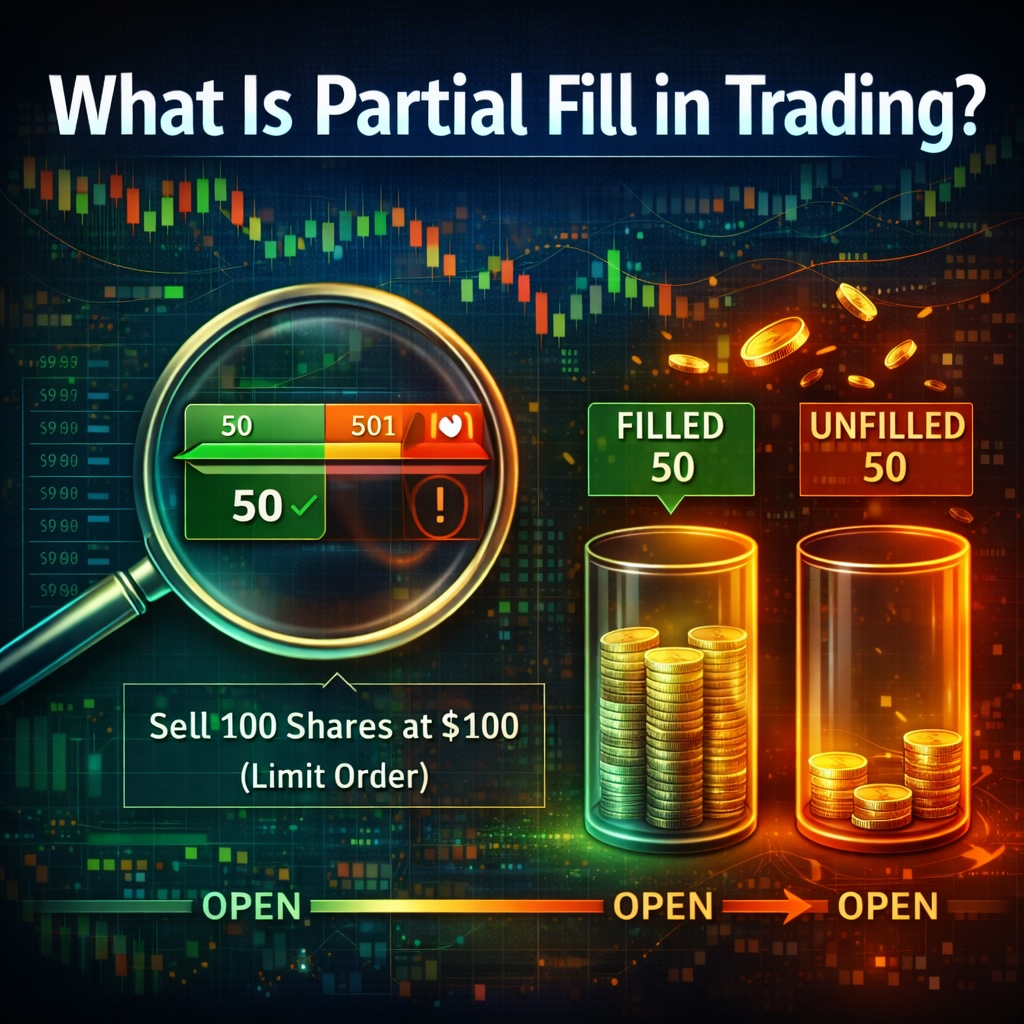
Partial fill in trading is a normal execution outcome, not a platform bug. It means your order is executed only in part, while the remaining quantity stays open until more liquidity appears or the order is canceled. Many newer traders expect every order to be filled as one clean block. Real markets do not always work like that. Order books are dynamic, queue positions matter, and available size at a specific price can disappear in milliseconds. For context, see limit order.
If you have ever asked, “What is a partial fill order, exactly?” the practical answer is simple: it is an order that can be matched in pieces. For example, you place a limit order for 1,000 shares, but only 300 are available at your price right now. You get 300 filled and 700 still pending. Depending on market conditions and order settings, the rest may fill later at the same level, fill at another level, or never fill at all. A useful companion topic is IOC and FOK.
This topic matters because execution details shape risk and performance. A strategy can look great in theory, but partial fills can distort position sizing, entry timing, and stop-loss logic. In this guide, we will cover what partial fills are, why they happen, how they appear in stocks and forex, and what practical pros and cons they create for active traders. You can compare this with market order vs limit order.
- Definition
- Why Partial Fills Occur (liquidity, order book)
- Example in stocks/forex
- Pros & Cons for traders
- Execution Checklist for Partial Fills
- Key Takeaways
- FAQ
- Is partial fill good or bad?
- How can I avoid partial fills?
- Do market orders also get partial fills?
- Does partial execution mean my broker is bad?
- What should I track after partial fills?
Definition
A partial fill occurs when the market cannot immediately match your full requested quantity at your chosen conditions. The key phrase is “cannot immediately.” Execution engines match orders against available counterparties. If enough size is not there at that moment, only a fraction of your order executes. The rest remains open in the order book (for eligible order types) and waits for new liquidity. For a deeper execution angle, review slippage in trading.
Think of it as inventory matching. You ask for a certain size at a certain price. The market offers only part of that inventory now. You receive what exists and wait for the remainder. This is why partial execution explained through order-book mechanics is more useful than treating it as random inconvenience. Once traders understand depth and queue dynamics, partial fills become easier to anticipate and manage. Related concept: execution speed.
Order type determines what happens next. A standard limit order can continue resting and collect additional fills over time. An IOC (immediate-or-cancel) order usually takes what it can instantly and cancels the rest. A FOK (fill-or-kill) order demands full immediate execution or no trade at all. So partial fills are not just about “market conditions”; they also depend on what execution rules you select before submitting the order.
Platforms may display partial fills as multiple execution lines under one order ticket. That can confuse beginners who expect one entry price. In reality, average entry price may be calculated from several partial matches. If you do not reconcile this correctly, your stop and target distances may be based on the wrong assumption.
Why Partial Fills Occur (liquidity, order book)
The most common reason is simple: insufficient liquidity at your exact price level. Suppose you place a buy limit at $50.00 for 2,000 shares. If the visible ask at $50.00 is only 450 shares, your first fill may be 450, with the rest waiting. In active names this may complete quickly. In thinner names, it may remain partially filled for a long time.
Queue position is another major factor. Even when size exists at your target price, other traders may be ahead of you in time priority. If incoming opposite orders are not large enough to clear the queue, only some participants are filled. You may receive a partial amount or none at all. This is common during popular levels where many traders stack orders around round numbers or obvious technical zones.
Volatility amplifies the issue. In fast markets, liquidity appears and disappears rapidly as participants cancel and repost quotes. You might see a price level on screen, send your order, and arrive after that displayed size is gone. The result can be partial execution or no execution despite “seeing” enough size moments earlier.
Venue structure also matters. Different venues and liquidity pools have different matching behavior, participant mix, and depth characteristics. A broker that aggregates multiple pools may fill your order in fragments across providers. That is still normal. In fact, multi-source matching can improve total fill probability, but often increases the chance of split executions.
Order size relative to average trade size is another overlooked variable. A ticket that is small in one instrument can be large in another. Traders who scale size without checking real depth often experience partial fills and assume something is broken. Usually nothing is broken; the requested size simply exceeds immediately available liquidity at that price.
Example in stocks/forex
Stocks example: You submit a limit buy for 3,000 shares at $24.80. The book currently shows 600 shares offered at $24.80, then 1,100 at $24.81, then 2,000 at $24.82. Because your order is a limit at $24.80, you receive 600 shares now and 2,400 remain open. If more sellers appear at $24.80, more of your order fills. If price lifts and never returns, the remainder stays unfilled unless you modify the order.
Forex example: You place a larger market order through a broker using multiple liquidity providers. The platform fills part of your order at the top quote, another part one pip away, and leaves a remainder pending briefly depending on execution mode. Your report shows several fills at slightly different prices. This is partial execution in practice, not necessarily poor execution quality.
What matters is how your trading system handles this reality. If your plan assumes one exact entry and one exact size, partial fills create operational friction. You may enter risk with half exposure, then add unintentionally during momentum, changing average price and trade context. Without explicit rules, the strategy becomes inconsistent.
A practical rule is to predefine behavior for incomplete fills: hold partial position, complete at adjusted limit, or cancel remainder after a time threshold. The correct choice depends on strategy type. For breakout systems, delayed completion can degrade edge. For mean-reversion systems, staged entries may be acceptable. The key is deciding before execution, not improvising under pressure.
Pros & Cons for traders
Pros: Partial fills can preserve price discipline. Instead of crossing the spread aggressively, you may secure at least some position at your preferred level. They can also reduce market impact compared with forcing full size instantly in thin conditions. For patient strategies, gradual completion can improve average cost if the market revisits your level.
Cons: The main drawback is execution uncertainty. Your final position size may differ from planned size, which affects stop placement, risk-per-trade, and expected payoff. Management complexity rises because you must track filled quantity, average price, and pending remainder in real time. If your broker charges per execution event, multiple partial fills may also increase total fees.
Psychology is another hidden cost. Traders often react emotionally when only part of an order fills, then chase the rest at worse prices. This behavior turns a neutral execution event into a negative decision event. The fix is process: define ahead of time whether and how to complete remaining quantity.
From a risk perspective, partial fills can be either helpful or harmful. Helpful when they reduce immediate exposure in unstable conditions. Harmful when they create fragmented entries that break system logic. The difference is not the partial fill itself—it is your rule set around it.
Professionals treat partial fills as a standard variable. They build sizing and execution policies that remain robust even when fills are fragmented. Retail traders can do the same with a few habits: monitor depth before sending size, match order type to objective, avoid oversized tickets in thin windows, and keep a post-trade execution log.
A useful practical routine is to run a weekly execution review. Group trades by instrument and session, then compare planned size versus immediately filled size. If partial fills cluster in specific conditions, adjust either timing or ticket size. This converts a frustrating execution symptom into an actionable process improvement loop.
Execution Checklist for Partial Fills
Before sending an order, confirm three things: expected depth at your level, acceptable completion time, and fallback action if only part fills. During execution, monitor filled quantity versus intended quantity and avoid impulsive chasing. After execution, reconcile average entry price and update stop-loss and take-profit levels based on actual filled size, not intended size.
A practical decision tree helps. If less than 30% of your target size fills and momentum is fading, cancel remainder and reassess. If more than 70% fills and structure remains valid, complete remainder using pre-set tolerance. If volatility expands beyond plan, reduce size rather than forcing completion. This process keeps execution aligned with strategy logic.
For active desks, partial-fill metrics should be part of weekly reporting: completion ratio, time-to-completion, adverse movement during completion, and incremental cost from fragmented fills. These numbers expose whether your issue is timing, venue selection, or ticket sizing. Once you identify the driver, improvements become systematic instead of emotional.
Key Takeaways
- A partial fill means only part of your order executes immediately.
- The core causes are liquidity depth, queue priority, volatility, and order design.
- Partial fills are common in both stocks and forex, especially for larger tickets.
- They are not inherently good or bad; impact depends on your execution rules.
- Predefined handling rules improve consistency and reduce emotional errors.
FAQ
Is partial fill good or bad?
It is neither by default. It can protect price quality, but it can also complicate sizing and trade management.
How can I avoid partial fills?
Use smaller order size, trade deeper liquidity windows, and choose order types like IOC/FOK when appropriate.
Do market orders also get partial fills?
Yes. In fragmented or fast markets, market orders can execute in multiple slices across levels or providers.
Does partial execution mean my broker is bad?
Not necessarily. It is often a normal consequence of market microstructure and available depth at the moment.
What should I track after partial fills?
Track final filled size, average entry, completion time, and impact on strategy performance by setup type.