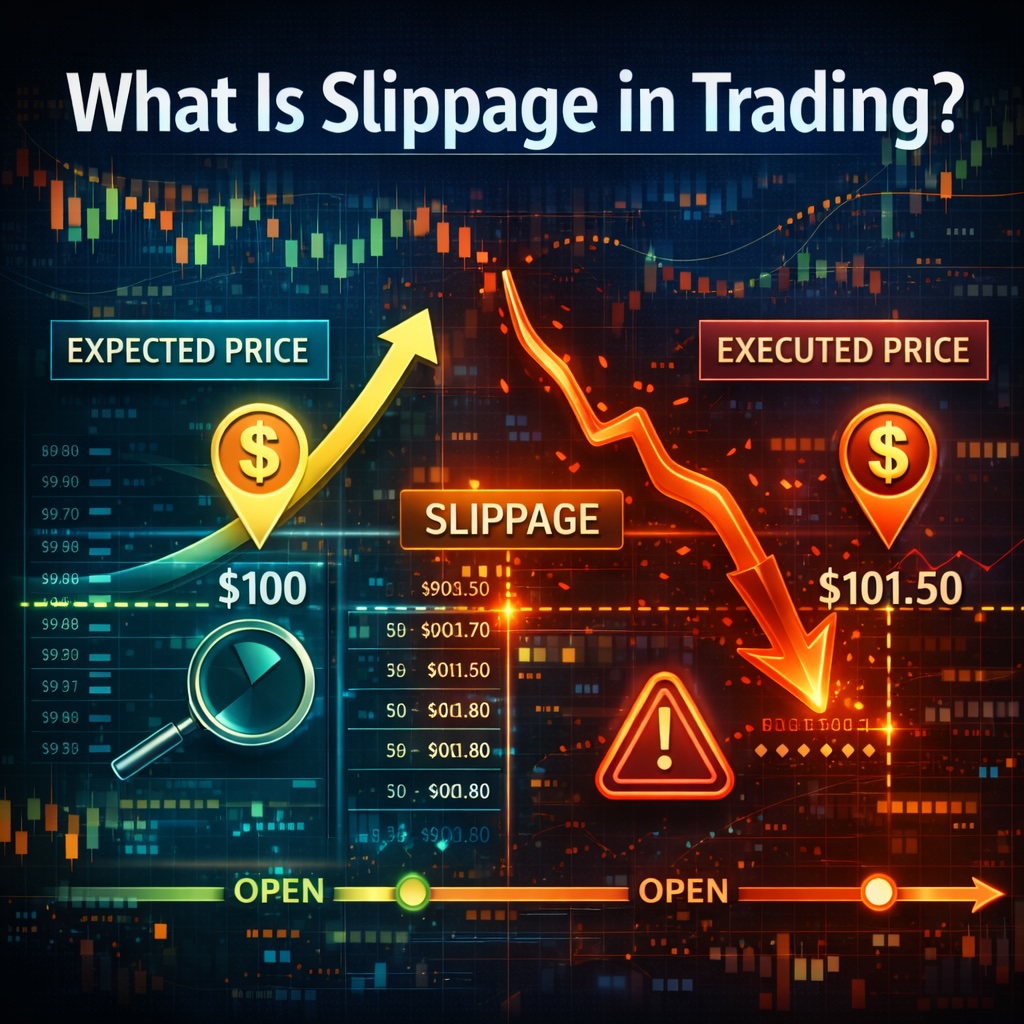
What is slippage in trading? It is the difference between the price you expected when placing an order and the price you actually receive when that order is executed. Every active trader meets this sooner or later. You click buy at one number, but your fill appears slightly higher. You click sell at one level, but the trade closes slightly lower. That gap can be small, but over many trades it becomes a real cost driver. Understanding slippage is not optional if you care about execution quality, realistic risk management, and long-term performance. For context, see order execution speed.
Most beginners treat chart analysis as the full game. In reality, there are two games running at once: finding a setup and getting filled efficiently. Slippage sits in the second game. You can have a valid idea and still underperform if your entries and exits are consistently worse than planned. This is why experienced traders track execution as carefully as they track win rate. If you do not measure slippage, you can misread your strategy, overestimate your edge, and size positions too aggressively. A useful companion topic is smart order routing.
This guide gives a practical, plain-English framework. We will define slippage, break down the main causes, walk through a trading slippage example in fast markets, compare positive and negative slippage, and finish with concrete methods on how to avoid slippage as much as possible. The goal is not to eliminate it completely—that is unrealistic. The goal is to control it, forecast it, and design your process around it. You can compare this with Time in Force.
- Definition & Causes
- Example in fast-moving markets
- Positive vs Negative Slippage
- What Is Slippage in Trading: How to Reduce It
- Practical Slippage Control Checklist
- Key Takeaways
- FAQ
- Can slippage be positive?
- Why does slippage happen more in forex/crypto?
- Is slippage the same as spread?
- Do limit orders completely solve slippage?
- What should I monitor to control slippage over time?
Definition & Causes
Slippage explained in one line: execution takes time, and prices can move during that time. Even in modern electronic markets, an order still goes through a path: your platform sends it, your broker routes it, a venue matches it, and confirmation comes back. If price changes while that path is happening, your fill can deviate from what you saw on screen. In stable conditions this may be tiny. In volatile conditions it can be meaningful. For a deeper execution angle, review partial fill in trading.
There are several common causes. Volatility is the obvious one. During macro news, earnings releases, or sudden crypto moves, quotes change rapidly and resting liquidity is pulled. Liquidity depth is another. If order-book depth is thin, your order may consume multiple levels, producing a worse average fill. Order size matters too: the bigger your trade relative to available liquidity, the higher the chance of slippage. Execution technology also plays a role—routing logic, server distance, and latency can all affect where you get matched. Related concept: market order vs limit order.
Order type is often overlooked. Market orders prioritize speed over price certainty, so they are naturally more exposed to slippage. Limit orders prioritize price but may remain unfilled if the market moves away. Neither order type is universally “best.” The right choice depends on context: urgency, liquidity, spread, and strategy horizon. A trader who always chooses one order type without context is effectively accepting hidden execution risk.
Session timing matters more than most traders realize. For forex, liquid overlap sessions typically offer tighter spreads and deeper books. For stocks, regular market hours usually provide better depth than premarket or after-hours windows. For crypto, liquidity can vary heavily by exchange and time block. If you repeatedly trade during thinner periods, you may incorrectly blame your strategy when the real problem is environment selection.
Finally, slippage is not always a broker “issue.” Sometimes it is pure market mechanics. In true market stress, there may simply be no one willing to transact at your expected level when your order arrives. The practical response is to model that reality in advance instead of pretending fills will always match ideal backtest assumptions.
Example in fast-moving markets
Let’s build a concrete trading slippage example. Imagine EUR/USD is trading at 1.1000/1.1001. You have a breakout setup and send a market buy right as a major U.S. inflation number is released. In less than half a second, buy pressure surges, offers disappear, and the best available ask jumps to 1.1004. Your order fills at 1.1004. You expected roughly 1.1001; you got 1.1004. That 3-pip gap is negative slippage.
Now include position size. If you traded one standard lot, that gap is manageable. If you traded larger size, the effect grows quickly. If your stop is tight, the trade can start at a structural disadvantage before the idea has time to work. This is why professionals stress execution-adjusted risk, not chart-only risk. The chart setup may look identical in two accounts, yet one account performs worse due to repeated adverse fills.
Crypto gives another useful example. Suppose BTC breaks above resistance and many market buys hit at once. A medium-size market order can sweep several ask levels, creating a blended fill above your trigger. In the trade log, the entry can appear far from the candle level that “looked available” on your chart. This is not unusual in fragmented order books, especially during momentum bursts.
Fast-moving markets also reveal a second effect: exits can slip too. Traders often focus on entry slippage and ignore stop execution. But in sharp reversals, stop-market exits can execute worse than planned. If your strategy assumes perfect stop fills, real drawdowns may exceed modeled drawdowns. That is why robust systems include slippage assumptions on both entry and exit, not just one side.
The key lesson from fast-market scenarios is simple: execution is probabilistic. You do not control the exact print; you control your preparation, order design, timing, and risk limits. The more structured your process, the less damage slippage can do to your edge.
Positive vs Negative Slippage
Many traders ask whether slippage is always bad. It is not. Negative slippage means your execution is worse than expected. Positive slippage means your execution is better than expected. Both outcomes can occur in fair, transparent matching environments. If a sell order gets filled at a slightly higher price than expected, that is positive slippage. If a buy order is filled lower than expected, that is also positive slippage.
In practice, traders remember negative events more vividly, so they feel slippage is always harmful. Behavioral bias matters here. One or two painful fills can shape perception, even if your broader data is balanced. The right approach is to use a sample: track expected price, actual fill, instrument, session, order type, and volatility regime across many trades. Then analyze distribution, not anecdotes.
If your long-run data shows only negative slippage with almost no positive offsets, investigate execution quality. Possible causes include weak routing, trading at poor times, excessive market-order usage in thin books, or oversized tickets. The solution is process improvement, not emotional reaction. Blaming “bad luck” repeatedly usually means your system lacks an execution layer.
Positive slippage should not be treated as free profit either. It is a byproduct of market dynamics, not a dependable alpha source. Good risk planning assumes conservative fills. If positive outcomes appear, they are upside variance. If your model requires frequent positive slippage to stay profitable, your edge is likely fragile.
A professional mindset is to normalize both sides: negative slippage is an expected cost to manage; positive slippage is an occasional bonus, not a foundation. This framing keeps expectations realistic and decision-making stable.
What Is Slippage in Trading: How to Reduce It
If you are searching for how to avoid slippage, the honest answer is reduction, not total elimination. Markets are dynamic, so some deviation is inevitable. But you can lower frequency and magnitude with disciplined execution design.
1) Use limit orders when price precision matters. A limit order defines your worst acceptable price. This is powerful when your setup is sensitive to entry level. The trade-off is non-execution risk: the market may move away without filling you. For many strategies, that is acceptable. Missing a trade is often better than forcing a poor fill.
2) Choose timing windows with deeper liquidity. Trade when your instrument is most active. Liquidity concentration usually improves fill quality and reduces jumps between levels. Avoid thin-session impulses unless your strategy is specifically built for them.
3) Avoid market orders into known volatility spikes. Around high-impact data or surprise headlines, market orders can produce large adverse slippage. If participation is necessary, reduce size, widen assumptions, or stage entries.
4) Split large orders. Instead of one big order that sweeps depth, slice into smaller tranches where possible. This can reduce market impact and improve average execution, especially in thinner books.
5) Audit broker and routing quality. Execution quality differs across brokers and account types. Compare slippage and fill consistency with real logs, not marketing pages. Look at median outcomes and worst tails.
6) Improve technical latency where relevant. Stable internet, low-latency routing, and for some workflows a nearby VPS can help. Latency does not explain everything, but it can materially affect fast systems.
7) Build slippage into your strategy math. Backtests and forward tests should include realistic slippage assumptions by instrument and regime. If the strategy fails under realistic execution costs, that is useful information—not a failure of modeling.
8) Keep an execution journal. Track expected vs executed prices, spread, volatility state, and order type. Over time you will see where slippage clusters. Those patterns guide practical improvements faster than intuition alone.
Practical Slippage Control Checklist
Before every trading week, define an execution checklist in writing. Set maximum acceptable slippage by instrument, preferred session windows, and order-type defaults for normal versus high-volatility conditions. If you trade news, decide in advance when you will use reduced size or stay flat. After each week, review your worst five fills and classify the root cause: timing, liquidity, order type, size, or latency. This turns slippage from a vague frustration into a measurable operating metric.
Also separate strategy failure from execution failure. If your setup logic was correct but execution quality was poor, the fix is operational, not analytical. If both failed, fix the setup first. Traders who combine these diagnostics improve faster because they know where edge is leaking. Over months, this discipline can produce a bigger performance gain than adding new indicators or more complex signals.
Key Takeaways
- Slippage is the gap between expected and executed price.
- It increases with volatility, thin liquidity, large size, and weak execution setup.
- Both negative and positive slippage exist; evaluate distribution over many trades.
- You cannot remove slippage completely, but you can reduce it through timing, order choice, and sizing.
- Strategy performance must be measured with realistic execution assumptions.
FAQ
Can slippage be positive?
Yes. Positive slippage happens when your order is filled at a better price than expected.
Why does slippage happen more in forex/crypto?
These markets can reprice quickly and liquidity can shift across venues in milliseconds, especially during news or momentum bursts.
Is slippage the same as spread?
No. Spread is the quoted bid-ask difference. Slippage is the execution difference between expected and actual fill price.
Do limit orders completely solve slippage?
They protect your maximum buy or minimum sell price, but they can reduce fill probability in fast markets.
What should I monitor to control slippage over time?
Track expected vs executed price by instrument, order type, session, and volatility regime, then adjust execution rules based on data.